The frontier of world models is moving toward continual learning! Researchers from New York University, in collaboration with Yann LeCun's startup AMI, have unveiled the latest breakthrough in the #JEPA series: AdaJEPA. Unlike conventional world models whose parameters are frozen post-pretraining, AdaJEPA adjusts the parameters of its encoder and predictor in real-time during environmental interactions through Test-Time Adaptation (TTA), achieving true continual learning.
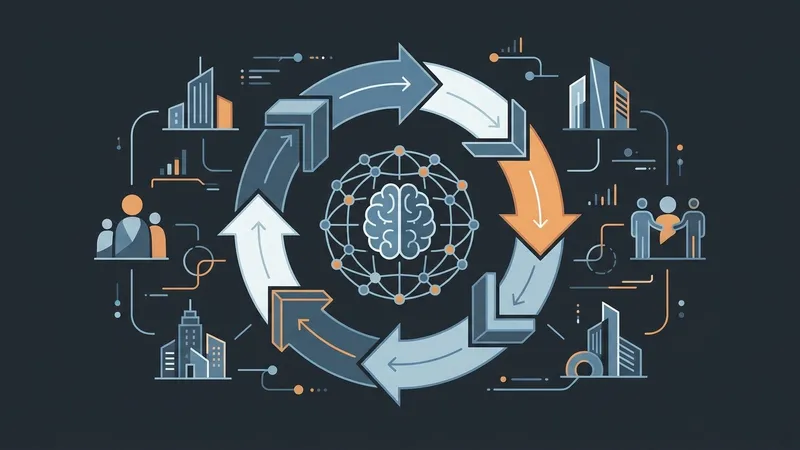
Specifically, AdaJEPA operates on a closed loop of planning, execution, observation, update, and re-planning. During each interaction, the agent only executes the first chunk of actions planned by Model Predictive Control (MPC), and then uses the actual observed next-frame state as a self-supervised signal to update the world model. Consequently, the model used in the next planning step is not the frozen model from initial deployment, but one "calibrated" by the current environment. This concept shares deep similarities with the classic Dyna architecture in reinforcement learning, where models continuously refine their understanding of the world via real-world interactions.
Historically, latent-space world models based on the JEPA pipeline have assumed frozen parameters during deployment. The typical workflow involves compressing high-dimensional images into a latent space using offline trajectories and predicting future states within this space. During test-time, MPC queries this frozen world model to roll out "imagined" futures and optimize action sequences. However, when faced with Test-time Distribution Shift, plans that look viable in the latent space often fail in the real environment. Since MPC relies on short-horizon rollouts, single-step errors compound rapidly.
To solve this, AdaJEPA reframes the traditional MPC loop into a four-step cycle: 1) Planning: Encode the current observation into a latent state and use MPC to roll out predictions, finding the optimal action sequence. 2) Execution: Execute only the first step of the planned action sequence and receive the next observation frame. 3) Update: Store the real transition in an online buffer, compare the predicted latent state with the encoded actual state, and backpropagate gradients to update the model. 4) Re-planning: The updated model is immediately deployed in the next MPC loop. By default, AdaJEPA only updates the last few layers of the encoder and predictor, performing only 1 step of gradient descent per re-planning cycle.
In terms of implementation, AdaJEPA is built upon the Joint-Embedding Predictive Architecture (JEPA). Unlike pixel-level predictive world models, JEPA predicts future states solely within a compact latent space. To prevent representation collapse during online updates, the framework implements a stop-gradient on the target representation and restricts updates to a small subset of parameters, enabling a lightweight, step-by-step calibration.
The team evaluated AdaJEPA on two major benchmarks: PushObj and PointMaze. On unseen object shapes in PushObj, AdaJEPA nearly doubled the planning success rate. In PointMaze with unseen layouts, the GD planning success rate rose from 53.3% to 78.7%, and the CEM success rate improved from 49.3% to 70.7%. Crucially, this online adaptation introduces minimal latency—only 0.01 to 0.03 seconds of additional overhead, demonstrating its practicality for real-world deployment.
[AgentUpdate Depth Analysis] AdaJEPA represents a critical shift for AI Agents from static planning to dynamic adaptation. Traditionally, world models serve as passive simulators, which limits generalization. By introducing Test-Time Adaptation (TTA) into the latent space, AdaJEPA enables real-time calibration under low latency. Compared to RAG or In-Context Learning in LLMs, AdaJEPA's self-supervised parameter updates directly recalibrate underlying physical representations, mitigating compound errors in MPC. For the future AI Agent ecosystem, this means embodied agents can rely less on massive offline pretraining, achieving high generalization via lightweight edge-level adaptation. This will accelerate autonomous agents' deployment in dynamic, high-precision industrial control and robotics.