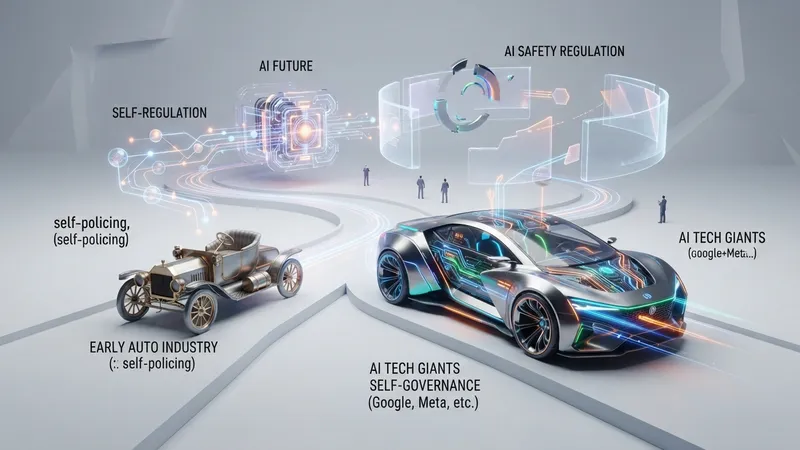
Here's a quick history lesson. In 1966, nearly 51,000 people died on US highways. Overwhelming evidence suggested that many lives could have been saved with modern seat belts, which had been available for years. The automotive industry, in a triumph of self-#regulation, did not voluntarily install this safety feature in every new vehicle.
Instead, in the fall of 1966, Congress established the Department of Transportation and passed the National Traffic and Motor Vehicle Safety Act as well as the Highway Safety Act. This granted the federal government sweeping new authority to set safety standards. By 1968, seat belts were mandated in every new car. Despite a massive increase in highway traffic over the last 60 years, fatalities on the road are far fewer today.
This historical context is relevant when observing various AI CEOs convening with US President Donald Trump to commend themselves on signing an AI safety accord. The underlying stipulation is that AI labs are largely responsible for #self-policing. As Trump succinctly stated in the Oval Office: "They’re gonna police, and they’re gonna police each other, and they’re gonna self-police, they’re gonna police themselves. It’s going to work out very well."
This encapsulates the current state of AI safety regulation. On one side, AI executives, employees, and tech luminaries advocate for clear, thoughtful, and tactical rules to avert potential disasters (Bill Gates, for instance, has warned of an AI apocalypse). On the other, there's a reliance on "magical thinking" that self-policing will suffice.
However, the issue is far from simple. The question of how to properly "pace the frontier," as some executives term it, remains open. Even if all major AI labs agreed to a slowdown, mechanisms to enforce this are lacking, and countries like China would likely continue their independent development. The US economy is increasingly propped up by the AI industry, which itself is a complex web of financing and circular investments; any significant crackdown risks major instability extending beyond Silicon Valley.
The automotive industry analogy, admittedly, isn't perfect. There's no direct "seat belt equivalent" for AI—no straightforward solution to demonstrably reduce risk overnight. (It also took decades for most states to mandate seat belt usage.) The potential harms of AI are less certain and harder to quantify. AI doomers predict human extinction within a decade, while skeptics dismiss this as sci-fi marketing.
[AgentUpdate Depth Analysis]
The discussion around AI safety, particularly the reliance on corporate self-regulation, has profound implications for the evolving AI Agent ecosystem. Unlike traditional models, autonomous agents possess greater decision-making and action capabilities, making their behavioral boundaries and potential risks more complex and unpredictable. Exclusive reliance on accords signed by a few leaders like OpenAI, Google, or Anthropic may not adequately govern a rapidly expanding ecosystem. For example, open-source frameworks such as LangChain and CrewAI have democratized agent development, simultaneously amplifying potential security vulnerabilities and misuse risks. Drawing parallels, the autonomous driving sector, despite ongoing technological iterations, has established preliminary international standards like SAE J3016 and national regulatory frameworks. The AI Agent domain urgently requires similar standards and safety protocols, particularly concerning ethical guidelines, accountability, and human-agent interaction in complex multimodal environments. Without independent regulatory oversight and mandatory compliance audits, relying solely on developers' "goodwill" could lead to the deployment of inadequately tested agents, introducing systemic risks. A robust future AI Agent ecosystem necessitates a multi-pronged approach: a synergy of industry self-regulation, standardized protocols, open-source collaboration, and robust governmental oversight to balance innovation with public safety.