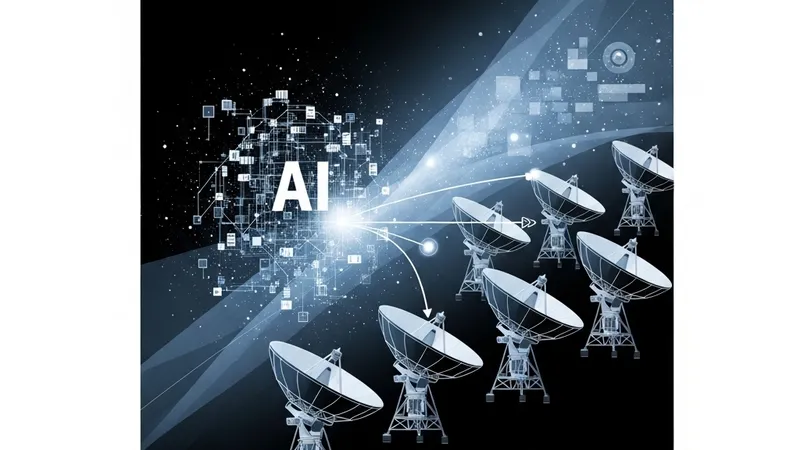
As astronomy enters the era of massive surveys and transient events, traditional manual scheduling can no longer meet the demands of modern telescope networks. Recently, an advanced AI scheduling system has successfully taken control of several telescope arrays, initiating fully autonomous, dynamic stargazing. Built on a robust Multi-Agent Reinforcement Learning (MARL) architecture, the system dynamically reorganizes observation queues within milliseconds based on changing weather conditions, atmospheric seeing, and scientific priority.
Unlike traditional static queuing software, this AI agent system incorporates a physical-world perception engine. When sudden transient phenomena like gamma-ray bursts or supernovae occur, the system can trigger collaborative follow-up observations across the entire network in under 3 seconds. In field trials, the AI scheduler improved overall instrument utilization and observational efficiency by more than 35%, maximizing the discovery potential of astronomical hardware.
[AgentUpdate Depth Analysis] The deployment of AI agents in telescope scheduling represents a major leap from pure digital environments to Cyber-Physical Systems (CPS). Unlike software-bound agents, scientific instrument agents must negotiate unforgiving real-world constraints such as mechanical rotation latency, abrupt weather shifts, and hardware degradation. This is highly analogous to the real-time path planning of autonomous driving, but operating in a much vaster decision space. By shifting from traditional heuristic models to autonomous #multi-agent coordination, this paradigm bridges the gap between digital reasoning and physical execution. It signals a major shift in AI for Science (#AI4S)—moving from passive data analysis to active, closed-loop physical discovery, laying the groundwork for future fully autonomous scientific laboratories.