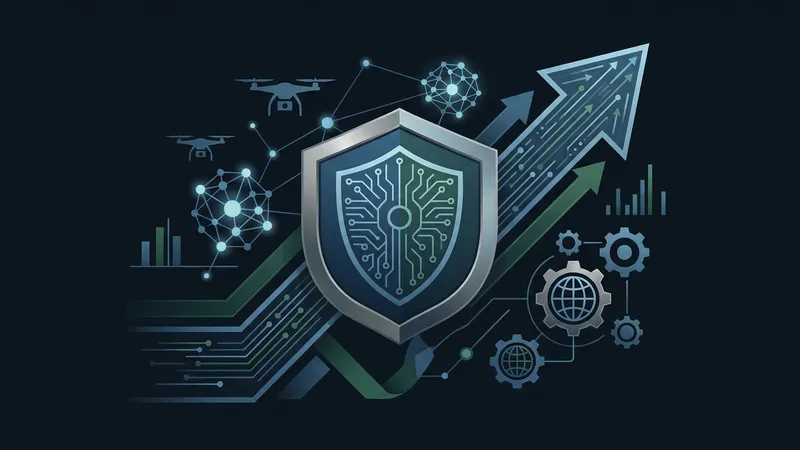
Artificial intelligence, particularly Large Language Models and autonomous agents, is radically redefining the landscape of national security. Traditional defense contractors are facing intense competition from Silicon Valley tech disruptors. Companies like Palantir and Anduril are integrating advanced AI decision-making algorithms into military command systems, such as the AIP and Lattice OS, granting private tech companies unprecedented power in national defense.
These systems go beyond data crunching; they are capable of real-time intelligence analysis and autonomous coordination of drone swarms and defense networks. In recent geopolitical simulated exercises, AI agents built on LLMs demonstrated decision-making speeds that outperformed human counterparts, reducing latency from hours to milliseconds. This efficiency has accelerated the pentagon's adoption of commercial AI solutions.
However, this shift raises serious concerns regarding the delegation of sovereign power. As the core "brains" of defense networks are built and maintained by private enterprises, national security becomes deeply intertwined with the software licenses and proprietary infrastructure of tech giants, giving tech executives a de facto veto power over critical capabilities.
[AgentUpdate Depth Analysis] This paradigm shift illustrates that AI Agents are transitioning from productivity utilities to strategic national security assets. Unlike traditional automated systems, modern defense-grade agents rely on real-time multimodal perception and dynamic tool-calling. By implementing interoperability protocols similar to the Model Context Protocol (#MCP), these agents seamlessly unify heterogeneous legacy military hardware and intelligence pipelines. In the long run, this dynamic will heavily influence the broader AI Agent ecosystem. Standards for safety, alignment, and offline execution will dictate the evolution of orchestration frameworks like LangChain or CrewAI. We foresee a bifurcation of the Agent industry, leading to a dedicated "Defense-Grade Agent Standard" that forces a decoupling from mainstream consumer AI, posing both massive commercial opportunities and ethical challenges.