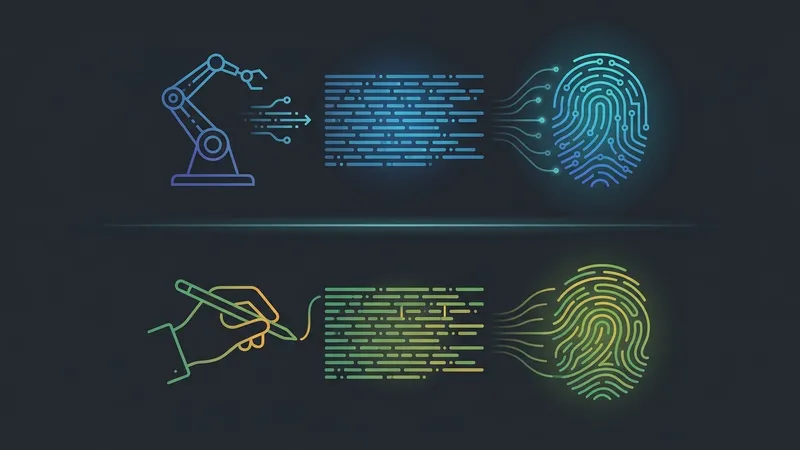
As large language models (LLMs) become ubiquitous, distinguishing human writing from AI-generated text has become a critical challenge. While past research shows that purely AI-generated texts carry distinct stylometric footprints, it remains unclear whether using LLMs to edit human writing leaves the exact same digital signature.
A new study accepted at EMNLP addresses this gap. The researchers demonstrated that AI generation leaves a highly consistent stylometric footprint. Across 8 distinct LLMs and 5 different domains, a tiny subset of features—primarily entropy and lexical diversity—consistently isolates AI-generated text from human writing.
However, AI editing does not follow this pattern. Compared to their human-written sources, AI-edited texts show only a minor bump in lexical diversity alongside a *decrease* in entropy, directly contradicting the joint increase observed in pure AI generation. Instead, lexical density emerges as the dominant identifier for AI editing, making edited text extremely hard to distinguish from purely human-written text using traditional methods.
These findings indicate that "AI text" is not a monolith. Current AI detection tools designed for generative text are fundamentally unsuited for identifying polished or edited text. The study suggests that researchers and developers must treat generation and editing as qualitatively different phenomenons that require distinct detection methodologies.
[AgentUpdate Depth Analysis] This study has profound implications for the AI Agent ecosystem, particularly for collaborative writing and agentic editing workflows. Currently, many productivity Agents operate on a "human-in-the-loop" model, where humans draft and Agents refine the output. Standard compliance and safety filters that flag "AI-generated" content will systematically fail or trigger false positives on these high-value hybrid workflows. By maintaining the underlying logical blueprint of human writing (low entropy) while applying precise linguistic enhancements, AI editing bypasses traditional stylometric baselines. This shifting landscape signals the obsolescence of static pattern-matching AI detectors. For the Agent ecosystem to mature, we must pivot from superficial linguistic analysis toward origin-tracking protocols and dynamic watermarking, encouraging Agents to preserve and adapt to unique human writing personas rather than homogenizing prose.