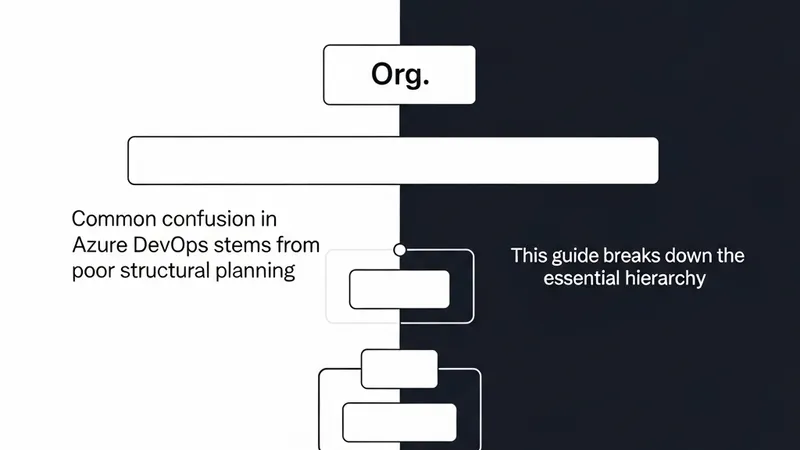
Much of the confusion in Azure DevOps starts before the first pipeline even runs.
Teams often open the portal, create a few repos, set up some boards, and keep moving. This works temporarily, but months later, no one is sure which project owns what, where shared code should live, or if a new team should create a new project or just add a random repo. This is typically a structure problem rather than a tooling problem.
If your Azure DevOps layout is clean, permissions are simpler to manage, pipelines are easier to reason about, and new developers can understand the system faster. The basic hierarchy works like this: Organization (top-level container) -> Projects (inside organization) -> Repositories (inside projects). Pipelines, boards, artifacts, and permissions typically attach at the project level and then get refined further.
What an organization should represent: An organization is the highest-level workspace. In most real setups, one organization maps to one company, one startup, or one major business unit. It owns users, billing, global access patterns, and the set of projects. A good default is one company = one organization. You usually do not want a new organization for every product or team unless there are strong reasons like legal separation, isolated billing, or hard security boundaries.
What a project should represent: A project is where teams make their main structural decisions. It commonly groups together boards, repos, pipelines, service connections, artifacts, and team-specific permissions. A clean mental model is: one project = one product, platform, or delivery stream (e.g., customer web platform, internal data platform). This does not mean one project per microservice; creating too many projects makes navigation, permissions, and pipeline management unnecessarily annoying.
What a repo should represent: A repo is where the actual code lives. Inside a project, you can have one or many repos depending on how your system is built, with each representing an individual application or service.
[AgentUpdate Depth Analysis] As the AI Agent ecosystem transitions to enterprise-grade deployments, classical DevOps structures like Azure DevOps are becoming the foundational blueprint for "AgentOps." When scaling multi-agent systems (such as AutoGen or CrewAI), defining secure boundaries and access control is a major hurdle. Mapping ADO's Organization-Project-Repo hierarchy to Agent governance offers an elegant solution. The Organization defines the global security boundary; Projects group specific Agent workflows along with their custom tools and credentials; while Repos store version-controlled prompt templates and microservices built by Agents. This structured approach simplifies secret management and ensures rigorous compliance when Agents autonomously commit code. Moving forward, AI Agents that seamlessly integrate with such proven DevOps frameworks will dominate enterprise platform engineering.