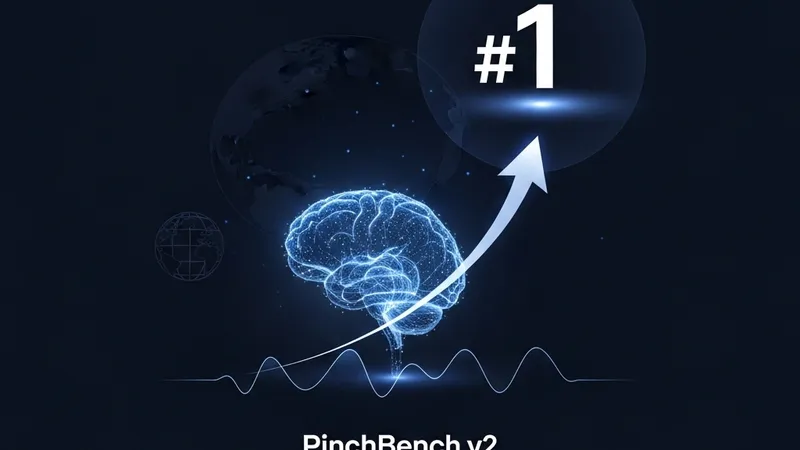
On July 17, 2026, the Baidu #ERNIE Assistant Task Agent claimed the top spot on the global engineering-focused AI agent benchmark, PinchBench v2, with a peak score of 94.6% and an average score of 94.4%. This marks the first time a Chinese domestic agent has ranked first as an active, commercial product, outperforming top global contenders such as Claude Opus 4.8-fast (93.5%) and GPT-5.6-luna (88.7%).
Maintained by the OpenClaw community, #PinchBench differs from static benchmarks like MMLU or GPQA by testing an agent's capability to deliver verifiable end-to-end results. Spanning 23 real-world scenarios and 147 tasks across categories like data analysis and code development, the evaluation runs on a dual-track mechanism of automated verification and LLM judging. Baidu has open-sourced the entire evaluation workflow and execution snapshots on GitHub for public replication.
In real-world tasks, ERNIE showed superb execution. In a financial analysis scenario, the agent autonomously retrieved earnings transcripts to calculate an operating margin outperforming guidance by 500 basis points. In cybersecurity, it successfully triaged Node.js vulnerabilities, prioritizing critical CVEs. It also demonstrated professional-grade performance in legal contract analysis, identifying over 22 client and vendor risks with maximum execution scores.
For everyday productivity, the agent excels in complex, multi-step dependencies. It can automatically clean tables and generate charts, design end-to-end travel itineraries from minimal user prompts, or run recurring workflows (such as delivering weekly HTML investment reports on tech papers) 24/7 without human supervision.
This breakthrough is anchored by Baidu's two decades of search technology pedigree. Built upon the multi-agent framework of the Orion AI Search Engine, the system leverages search's inherent "intent-disassemble-call-verify" loop. The results indicate that in the Agent era, framework engineering is becoming a more critical factor in task success rates than pure model parameter size.
[AgentUpdate Depth Analysis] Baidu's triumph on PinchBench v2 underscores a pivotal shift in the AI landscape from model-centric to system-centric paradigms. While horizontal frameworks like LangChain or CrewAI excel at basic orchestration, Baidu's approach of leveraging its proprietary "Orion AI Engine" demonstrates the transformative power of integrating search-grade engineering into the Agent workflow. By mastering intent parsing, tool execution, and self-correction, Baidu has set a new standard for end-to-end task automation. This shift signals that the future competitive moat of AI enterprises will be defined by their orchestration engine rather than base model parameters alone, bridging the gap between passive chatbots and highly autonomous, goal-oriented digital workers.