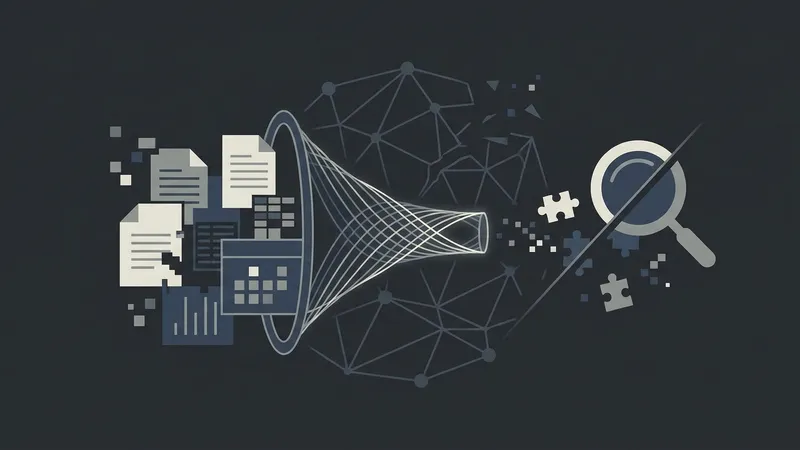
When using Retrieval-Augmented Generation (#RAG) for complex analytical tasks spanning hundreds of documents, such as financial due diligence or regulatory compliance reviews, organizations often hit a performance ceiling. While similarity search surfaces relevant fragments, it frequently misses cross-document connections. To bridge this gap, #AWS introduces Task-Aware Knowledge Compression (TAKC), a technique that pre-compresses entire knowledge bases into task-specific representations deployed on AWS.
Consider a private equity firm evaluating a $500 million acquisition of a manufacturing company. The due diligence team must analyze financial statements spanning 12 subsidiaries and 5 years, along with 200+ supplier contracts, environmental compliance reports from 8 facilities, and over 50 legal cases. When asking about consolidated financial risks given current supplier terms and pending litigation, traditional RAG's similarity search cannot surface the response. Hundreds of documents hold the relevant information, but the connections between them share no lexical similarity.
TAKC addresses this problem by using an #LLM to produce shorter, task-focused summaries of documents, tailoring the compression output to different tasks. An annual report compressed for financial analysis retains revenue figures, margins, and cash flow data, whereas the same report compressed for compliance review preserves regulatory citations and violation histories. Generic summarization dilutes information density, whereas TAKC compresses documents through the lens of a specific task, discarding irrelevant data.
For production deployments, task-type prompts are stored in a versioned configuration like AWS Systems Manager Parameter Store or a dedicated Amazon S3 prefix, ensuring prompt changes are auditable and recompression can be triggered automatically. The system compresses documents offline, once per document per task type. At query time, the system retrieves a pre-compressed representation rather than the original document.
If the compressed representation lacks sufficient detail, a Query Complexity Analyzer routes the query to a lower compression tier that retains more context. TAKC provides access to the entire knowledge base in compressed form, rather than just the top-k chunks returned by traditional similarity search, successfully preserving intricate connections across documents.
[AgentUpdate Depth Analysis] TAKC represents a paradigm shift from passive document retrieval to active semantic reconstruction for enterprise AI. Compared to GraphRAG, which incurs high costs in graph construction and maintenance, TAKC offers a more cost-effective way to handle heterogeneous unstructured data by pre-compressing information offline, significantly reducing online token consumption. For the AI Agent ecosystem, this serves as critical infrastructure for managing long-term memory and context windows. Future advanced agents will transition away from raw text retrieval. Instead, they will utilize TAKC-like "task filters" to dynamically load pre-compressed, structured, and task-specific knowledge. This mechanism not only enhances the reasoning accuracy of agents in executing complex, multi-step decision chains but also paves the way for scalable multi-agent systems to operate efficiently within enterprise environments.