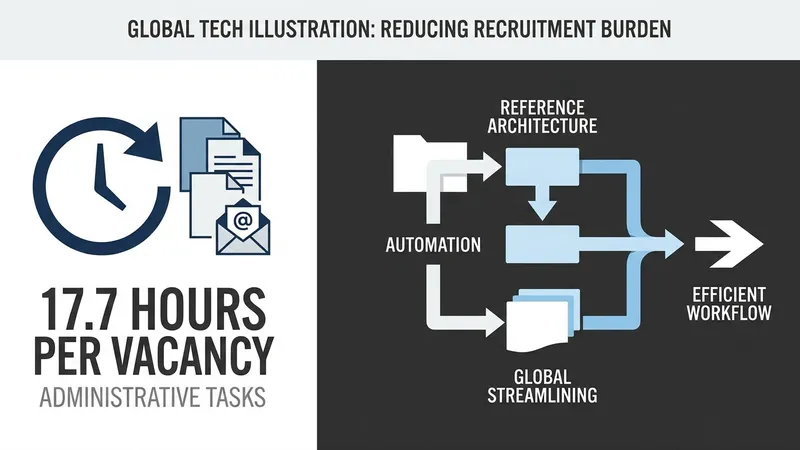
According to a people management survey of 748 HR leaders, recruiters spend an average of 17.7 hours per vacancy on administrative work—equivalent to more than two working days per hire. Furthermore, a 2024 SmartRecruiters survey highlighted that 45% of talent acquisition leaders spend over half their working hours on tasks that could be automated. This administrative burden forces superficial screening, which frequently overlooks qualified candidates while advancing resumes based on formatting and keyword density rather than genuine competency alignment.
In this post, we demonstrate how to build an AI-powered recruitment assistant using Amazon Bedrock to bring efficiency to candidate evaluation, generate personalized interview questions, and provide data-driven insights for human hiring decisions. Note that this is a reference architecture for educational purposes rather than a production-ready solution. Amazon Bedrock and the utilized AWS services are general-purpose tools that customers can combine to support a wide variety of use cases, including recruitment workflows.
You will learn to deploy specialized AI capabilities for resume parsing, candidate scoring, skill assessment, and interview question generation. These work together through a coordinated serverless architecture, with Amazon Bedrock Guardrails providing PII anonymization, prompt attack detection, and bias-related content filtering. The technical implementation utilizes the Amazon Bedrock Converse API with Amazon Nova Pro, AWS Lambda for processing, Amazon API Gateway for routing, Amazon DynamoDB and Amazon S3 for data storage, and Amazon Bedrock Guardrails for responsible AI evaluation.
Solution Architecture Overview
The AI candidate screening assistant leverages foundation models (FMs) available in Amazon Bedrock to streamline candidate evaluation. The frontend and authentication layer uses AWS Amplify to host the web application and Amazon Cognito for secure user authentication (JWT validation on every API request via API Gateway). The backend layer uses Amazon API Gateway to route requests to specialized AWS Lambda functions, each of which handles a specific workflow and invokes the Amazon Bedrock Converse API to perform deep resume analysis, calculate compatibility scores, and generate role-specific interview questions.
[AgentUpdate Depth Analysis] This architecture highlights a critical shift in enterprise AI Agent deployment: moving from monolithic designs to decoupled, task-specific microservices. By orchestrating workflows via AWS Lambda and securing them with Bedrock Guardrails, the system directly addresses the biggest hurdles in production-grade Agents: data safety and prompt manipulation. Guardrails provide out-of-band PII masking and prompt injection defense, which is far more robust than standard prompt engineering. Compared to open-source middleware solutions, this serverless approach guarantees enterprise-grade scalability and lower latency. The future of AI Agent ecosystems belongs to such 'compute-model-safety' decoupled architectures, where agentic execution is continuously audited by native safety layers.