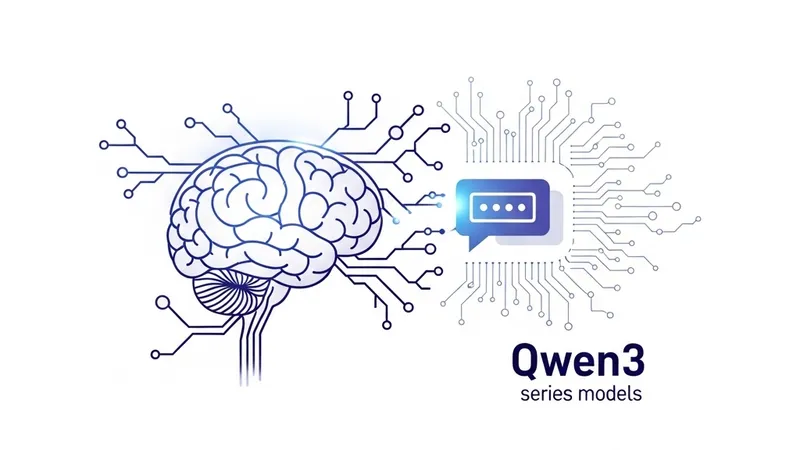
The artificial intelligence landscape has advanced rapidly with the release of Qwen3, a comprehensive series of open-weight large language models demonstrating state-of-the-art performance across diverse domains. Representing a significant leap from Qwen2.5, Qwen3 introduces revolutionary features that redefine human-AI interaction.
At the core of Qwen3 is its unique dual-mode architecture, seamlessly integrating both thinking and non-thinking modes within a single model. This innovation eliminates the need to switch between different models (such as transitioning from Qwen2.5 to QwQ) depending on the task's complexity, thereby streamlining deployment pipelines and reducing overhead.
The thinking mode enables deep, step-by-step #reasoning via extended Chain-of-Thought (CoT) processes, making it highly suitable for complex mathematical queries, advanced coding, and multi-step tasks. Conversely, the non-thinking mode delivers fast, direct answers for simple queries. With adjustable thinking budgets, users gain fine-grained control over computational costs and latencies.
In this guide, we walk through building an interactive chatbot application using Qwen3-Instruct, Qwen3-Thinking, and Gradio. Using PyTorch and the Hugging Face Transformers library, we detail everything from dependency installation and pipeline initialization to multi-turn conversation testing and local hosting.
[AgentUpdate Depth Analysis] The introduction of a dual-mode reasoning paradigm and flexible "thinking budgets" in Qwen3 marks a pivotal moment for the AI Agent ecosystem. Historically, Agent systems relied heavily on external routers, heuristic prompt templates, or orchestration frameworks like LangChain to delegate tasks between fast, cheap models and heavy reasoning models. By unifying these capabilities within a single model weight, Qwen3 drastically reduces operational latency and state-management overhead. This natively supports Kahneman's "System 1 and System 2" thinking within a singular agentic workflow. As AI Agents transition to fully autonomous workflow executors, the ability of models to dynamically negotiate their own reasoning computational budgets will become a foundational primitive, setting a new benchmark for agentic runtime efficiency.