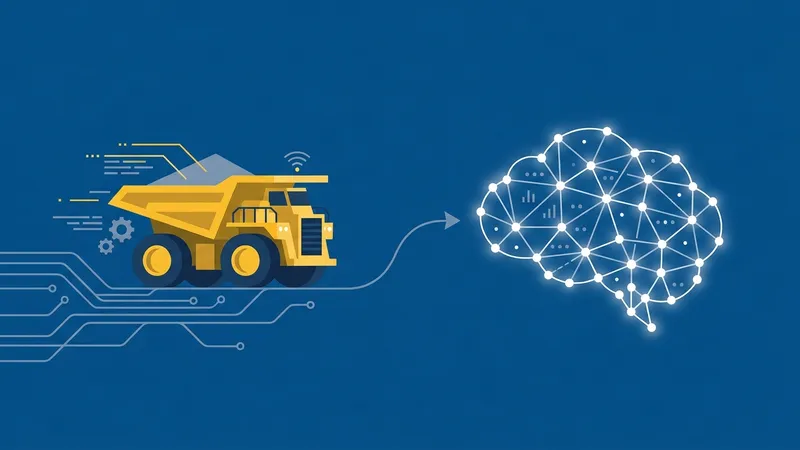
Almost every company attempting to deploy artificial intelligence runs into the same bottleneck: integrating the technology into everyday operations. Industrial heavyweight Caterpillar has spent decades dealing with a physical-world version of this problem, and is now leveraging its vast experience to accelerate AI deployment.
Caterpillar’s journey into autonomy began in mining, where labor shortages and hazardous environments make automation highly valuable. Today, the company offers autonomous haul trucks, drilling systems, underground loaders, and dozers, alongside a software command center, fleet management, and remote terrain intelligence as part of its toolkit.
"Now we’re in this super exciting time where we can take all of that learning from mining and bring it into much more dynamic environments, jobsites, quarries, and construction sites," Caterpillar CTO Jaime Mineart shared during a fireside chat at the Ai4 conference in Las Vegas.
The industrial giant is now expanding its AI applications, particularly for technicians and operators. A key example is the Cat AI Assistant, which enables field technicians to use voice commands next to a machine to retrieve repair procedures, troubleshoot potential issues, and identify required parts before starting maintenance. Mineart noted that the tool is already active with customers and operators.
The assistant leverages Caterpillar’s rich proprietary dataset, drawn from its connected machinery. Mineart noted that Caterpillar manages approximately 1.6 million connected assets globally, generating over 16 petabytes of structured data.
Additionally, Caterpillar uses AI to power site scanning and generate digital twins in manufacturing to analyze operations. Like many enterprises, it is also integrating AI across internal operations and software development. "We use AI agents to modernize legacy code, generate and test new software, and identify defects earlier," Mineart explained.
However, Mineart emphasized that building the technology is only half the battle; deploying autonomous machinery is not the same as transforming a site to use AI. "The hard part about autonomy and about physical AI is incorporating that technology into the customer jobsite and into the workflows," she stated. Companies must rethink how humans and machines collaborate.
To train its AI systems, Caterpillar relies heavily on the decades of institutional knowledge held by experienced operators. As machines become more autonomous, operators are transitioning from manual control of a single machine to supervising multiple units from a remote command center. This shift highlights a major internal focus: training its workforce of 118,000 employees.
[AgentUpdate Depth Analysis] Caterpillar’s strategic transition from physical mining automation to enterprise-wide AI deployment offers a definitive blueprint for the integration of Physical AI and AI Agent ecosystems. While many tech startups struggle to find viable business-to-business use cases for LLMs, Caterpillar capitalizes on its unmatched moat: 16 petabytes of proprietary physical-world data and 1.6 million connected assets. This industrial-grade data asset, combined with specialized #AI agents, bridges the gap between digital reasoning and physical action. Comparing this to autonomous driving efforts like Tesla's FSD, Caterpillar's approach proves that the most impactful future for AI agents lies in heavy industry and complex physical workflows. Ultimately, the evolution of the AI Agent ecosystem will be driven not just by raw algorithmic power, but by the seamless orchestration of software agents controlling heavy machinery under human-in-the-loop supervision, redefining industrial productivity globally.