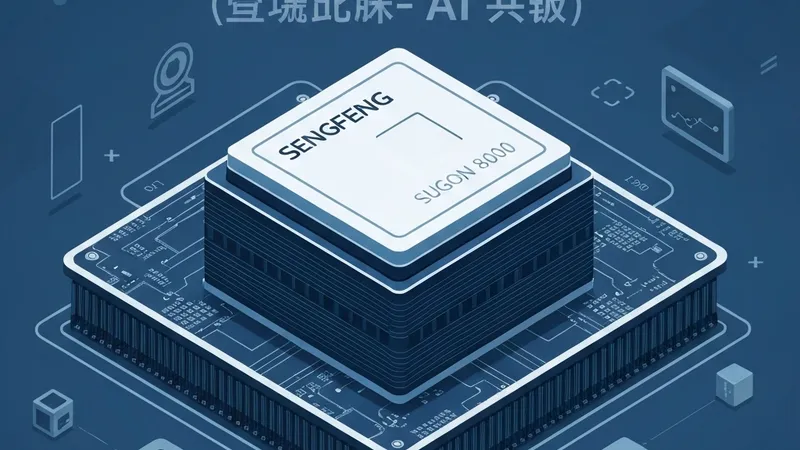
China has reached a significant milestone in AI infrastructure. On July 10, Sugon announced the launch of Dengfeng (#Sugon 8000), the nation's first 100,000-chip AI super-cluster, located in Zhengzhou. Rather than a mere expansion of capacity, this cluster utilizes a 'native super-intelligence fusion' architecture, covering the entire spectrum from FP64 double-precision scientific computing to INT8 large-model training, resolving the long-standing industry dilemma of fragmented computing tasks.
Engineering-wise, the Sugon 8000 demonstrates full vertical integration. It is powered by Hygon domestic processors, utilizes scaleFabric for native RDMA high-speed networking, and leverages the ParaStor distributed storage system—which topped the 2026 IO500 list—to ensure massive data throughput during heavy training loads. Furthermore, advanced liquid cooling technology from Sugon Data Center maintains high energy efficiency even at MW-scale power density.
Currently, the cluster is integrated into the National Supercomputing Internet, successfully accelerating complex tasks such as protein folding, turbulence simulations, and quantum simulations. By embracing an open AI computing architecture, it maintains compatibility with mainstream software ecosystems, significantly lowering the barrier for developers to transition existing models to domestic hardware.
[AgentUpdate Depth Analysis] The launch of Sugon 8000 signals a pivotal transition for domestic computing from 'isolated breakthroughs' to 'integrated ecosystem scale.' As AI Agents become increasingly reliant on massive-scale inference and complex task orchestration, traditional clusters often suffer from I/O bottlenecks and instruction-set incompatibilities that frustrate 'intelligent' versus 'scientific' resource allocation. Sugon’s 'fusion' architecture addresses this by decoupling hardware layers to provide a unified foundation for autonomous agent clusters. Compared to NVIDIA's Blackwell architecture, Sugon's fully domestic stack offers unprecedented supply-chain security and architectural sovereignty, which are cornerstones for the future Chinese AI Agent ecosystem. Looking ahead, this cluster represents more than just raw power; it provides the high-bandwidth, low-latency shared environment necessary to train agents with advanced logical reasoning capabilities. In the long term, these sovereign, high-availability computing nodes will serve as the essential infrastructure for China’s AI research, creating a virtuous cycle between algorithmic advancement and engineering implementation.