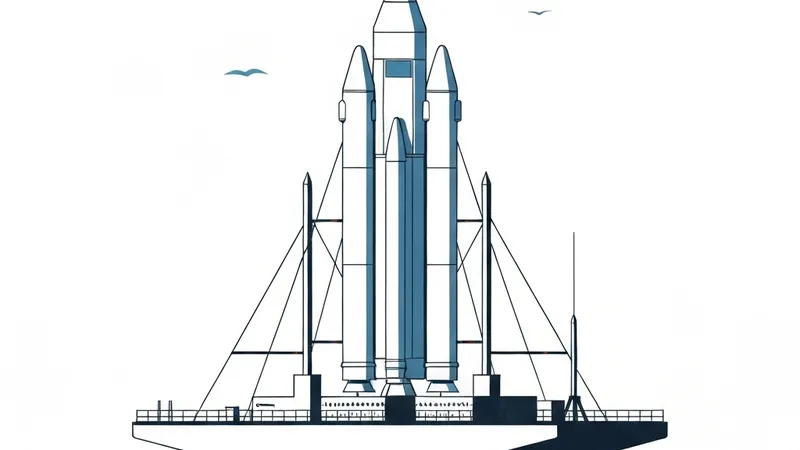
On July 10, 2026, China's space program achieved a historic milestone. The Long March 10B carrier rocket was successfully launched from the Hainan Commercial Space Launch Site, sending its satellite payload into orbit. Crucially, the rocket's first stage successfully completed a controlled, vertical landing on a sea-based platform, marking China's first-ever controlled recovery of a rocket's first stage.
The recovery mission utilized an innovative, specially designed flexible buffer interception and capturing net system on the sea platform. This engineering breakthrough effectively resolved the stability and load concentration issues associated with reclaiming heavy-tonnage aerospace components. With this successful operation, China has officially become the second nation globally, after the United States, to master heavy-payload reusable rocket technology.
In other global engineering and political developments, construction has officially commenced on New York's 2 World Trade Center, a $4 billion project set to incorporate cutting-edge smart-infrastructure systems. Meanwhile, Japan's House of Representatives passed a landmark amendment to the Imperial House Law, allowing female members to retain their royal status after marriage to combat the demographic crisis of a shrinking royal lineage. Key bilateral movements also progressed as China-Namibia, India-Australia, and South Korea-Mongolia secured major cooperations centering on critical minerals and supply chain resilience.
[AgentUpdate Depth Analysis] The successful sea recovery of the Long March 10B is not just an aerospace triumph, but a pinnacle demonstration of Physical Agents operating under extreme, high-dynamic real-world environments. Unlike classical automation, rocket retro-landing demands millisecond-level decision-making in highly unpredictable environments. The rocket's Guidance, Navigation, and Control (#GNC) system acts as a highly autonomous Physical Agent, utilizing Model Predictive Control (MPC) and real-time trajectory optimization to counteract wind shears and platform movements. Comparing this to SpaceX's Falcon 9 legs or Starship's 'Mechazilla' chopsticks, China's flexible buffer net system introduces a unique mechanical-interaction paradigm. As Embodied AI shifts from digital sandboxes to heavy industries, these hard real-time edge-computing agents will redefine autonomous systems, paving the way for advanced multi-agent coordination in deep space exploration and heavy industrial automation.