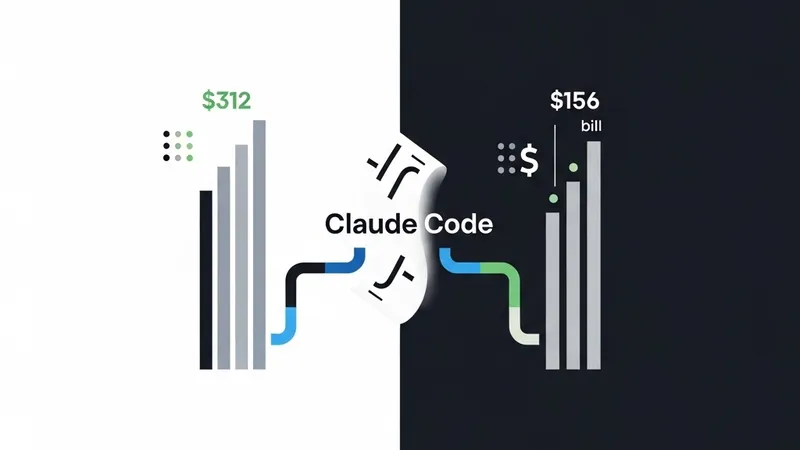
Many developers are finding that Claude Code can run up an unexpectedly high bill. One developer identified that 60% of a $312 Anthropic bill was caused by a specific pattern: whenever a wrangler d1 migrations task failed, the agent would trigger 7–8 retry bash calls to diagnose the error, burning 40K-60K tokens per loop. This behavior effectively evaporated funds without any productive outcome.
The fix didn't require complex prompt engineering, but rather a PostToolUse hook. By writing a simple script, the developer blocked the agent from entering a retry spiral by triggering an alert and storing the state in Cloudflare KV the moment the migration exited with a non-zero code. This allows for human intervention via a Slack bot before the agent wastes further budget.
Additionally, the developer implemented a PreToolUse hook to prevent accidental deployments from the main branch, and a pre-commit hook to scan for hardcoded production secrets. By adding these safeguards, the developer successfully reduced their monthly expenditure to $156 while hardening their development pipeline against both cost leaks and deployment errors.
[AgentUpdate Depth Analysis] This case highlights a critical bottleneck in the current AI Agent ecosystem: the lack of real-time operational oversight for autonomous tools. While models are becoming increasingly proficient at code generation, their propensity for "retry-loops"—especially when dealing with brittle CLI environments—creates significant financial risk. By treating Agent control through the lens of classical DevOps hooks, the developer effectively created a deterministic guardrail for a probabilistic system. Unlike high-level frameworks like LangChain, which manage orchestration, these low-level hooks provide the necessary constraint-based governance that LLMs lack natively. As we move toward more autonomous coding agents, the integration of observability and human-in-the-loop triggers will be mandatory. This approach represents a shift toward "Governance-as-Code" for AI, ensuring that agents function within predefined economic and operational boundaries. Future enterprise deployments will likely demand this level of granular control to mitigate the risks of runaway agentic behavior and ensure that token-based resource allocation remains economically viable.