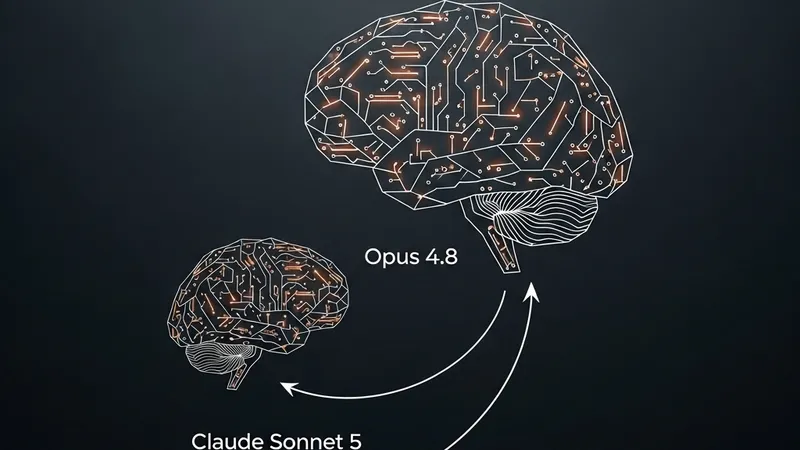
This morning, Anthropic officially rolled out Claude Sonnet 5. According to the newly updated developer documentation, its performance is remarkably close to the flagship Opus 4.8 but offered at a much more competitive price. The model's system card explains its regulatory compliance: Sonnet 5 is significantly less capable at cyber tasks than Mythos 5, allowing it to bypass stringent US government blocks with safeguards matching those of Opus 4.7 and 4.8.
For developers, the API adjustments bring massive architectural shifts. Classic sampling parameters like temperature, top_p, and top_k are no longer supported, indicating a transition to highly managed model inference. The model features an expansive 1-million-token context window and an unprecedented 128,000 maximum output tokens. Furthermore, adaptive thinking is now enabled by default, though developers can still disable it manually using 'thinking': {type: 'disabled'}.
While the nominal pricing matches Sonnet 4.6 at $3/million input and $15/million output (with introductory discounts running through August 31st), a hidden cost factor has emerged. Sonnet 5 introduces a new tokenizer that generates approximately 30% more tokens for the exact same source text compared to Sonnet 4.6, representing a functional price hike for many tasks.
Empirical tests using token counters reveal how this impact varies by language and code. The token count for English documents expanded by 1.42x, Spanish by 1.33x, and Python code by 1.28x. Interestingly, Simplified Mandarin remained practically unaffected at a mere 1.01x increase, making the model highly cost-effective for Chinese-language applications.
[AgentUpdate Depth Analysis] The launch of #Claude Sonnet 5 signals a major turning point for the AI Agent ecosystem. By deprecating raw sampling parameters (like temperature) and making adaptive thinking the default state, #Anthropic is pushing LLMs away from unpredictable raw completions toward highly standardized, deterministic reasoning systems. The massive 128,000 output token limit is a game-changer for agentic workflows; it allows agents to run continuous, deep chain-of-thought processes and generate large-scale codebase modifications without the fear of truncation. Moreover, the #tokenizer's asymmetric impact—where English and Python code costs spike by 30% while Chinese remains virtually unchanged—creates a unique economic advantage for localized Asian markets. This cost structure will likely accelerate the development of complex, domestic enterprise agents in China, shifting the ROI calculus in favor of large-context Chinese multi-agent systems.