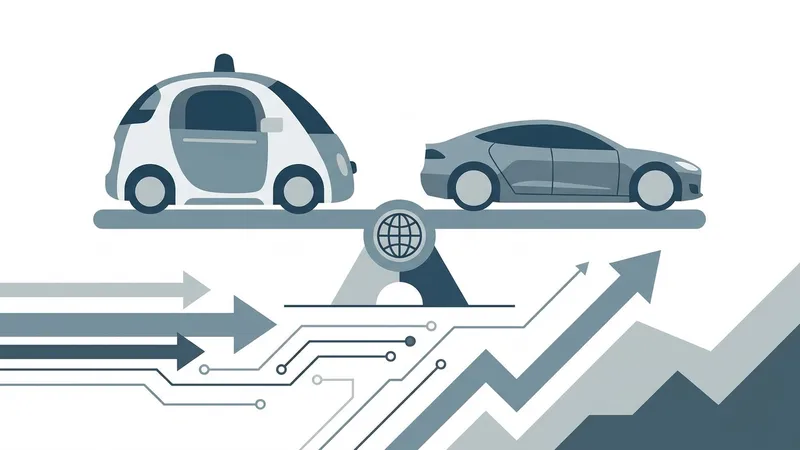
The global autonomous driving industry is undergoing a profound paradigm shift, signaling that the real Robotaxi revolution has arrived. Alphabet's Waymo has scaled its driverless services across multiple US cities, recently surpassing 100,000 weekly trips. Concurrently, Tesla unveiled its highly anticipated Cybercab, a dedicated #robotaxi with no steering wheel or pedals, charting a bold path powered by pure-vision, unsupervised FSD (Full Self-Driving). The clash between these two giants represents not just commercial competition, but an ultimate showdown of underlying AI technical paths.
Traditional autonomous driving systems relied heavily on expensive LiDAR arrays, high-definition mapping, and millions of lines of hand-coded rules. While reliable within geo-fenced areas, this approach suffers from high hardware costs and poor scalability. The next generation of autonomous driving is pivoting entirely toward Transformer-based End-to-End deep learning. By feeding raw camera feeds directly into a neural network that outputs steering, acceleration, and braking commands, AI is learning to drive with human-like intuition and spatial awareness, significantly reducing hardware costs and unlocking rapid generalization.
With the integration of Vision-Language-Action Models (VLAs), Robotaxis are evolving from mere vehicles into highly sophisticated physical agents. These agents must make split-second, safety-critical decisions while understanding complex implicit social norms on the road. The deployment of systems like FSD V12 proves that end-to-end neural networks can self-improve at scale, providing the most robust, real-world engineering blueprint for the broader Embodied AI and robot agent ecosystems.
[AgentUpdate Depth Analysis] Autonomous driving represents the most sophisticated and high-stakes deployment of AI Agents in the physical world. Unlike software-based agents operating within sandboxed APIs, Robotaxis must make millisecond-level decisions with life-and-death consequences. The transition to end-to-end neural networks not only resolves the long-standing "edge case" dilemma but also lays down the technical blueprint for Embodied AI scaling. Looking ahead, we foresee a convergence where digital and physical agent architectures unify under multimodal foundation world models. The scaling of Robotaxis will accelerate the digitization of physical spaces and spatial computing, establishing autonomous vehicles as the most capital-efficient, data-rich, and commercially viable backbone of the broader AI Agent ecosystem, bridging the gap between digital intelligence and physical reality.