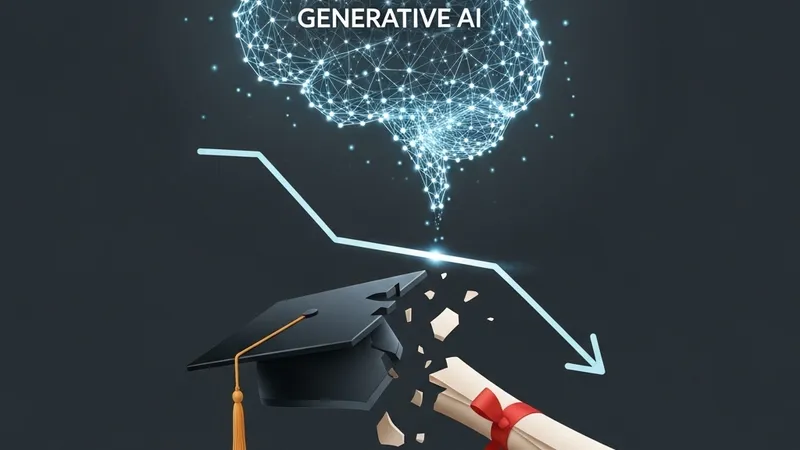
Choosing a university degree has never been more challenging in the age of generative AI. Powerful tools like ChatGPT and Claude are fundamentally disrupting career certainty, leaving students and parents struggling to predict which skills will remain viable and how AI will transform their chosen professions.
Generative AI already excels at drafting reports, writing code, analyzing data, and generating high-quality content. Although not yet infallible enough to fully replace professional human expertise, it is rapidly redefining entry-level work. A recent survey of New Zealand business leaders revealed that 87% of organizations saw roles change or vanish due to AI, with one-third slowing down entry-level hiring.
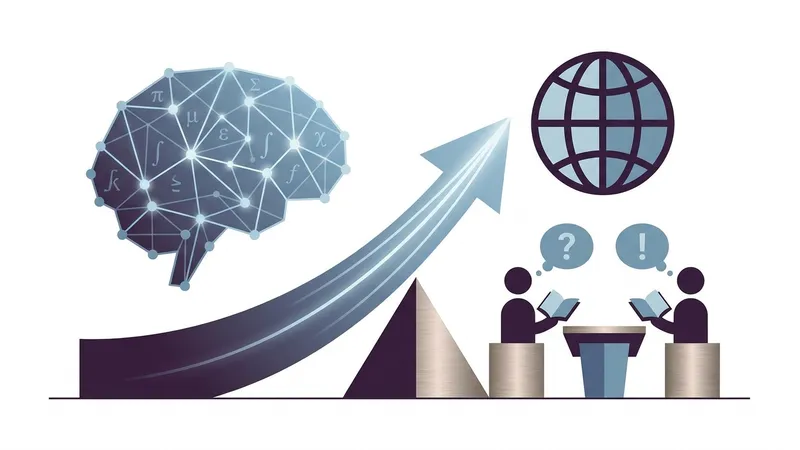
This shift poses an awkward question for universities: if AI can handle tasks traditionally used to assess graduate competence, what is the value of a degree? The solution is not to abandon traditional disciplines or turn every student into a computer scientist. Instead, universities must reconsider how early students specialize and foster genuine cross-disciplinary learning.
The most pressing global challenges, such as climate change and public health, transcend single disciplines. While AI lowers the barrier to accessing neighboring fields, it also makes superficial understanding easier to disguise. Polished AI outputs can easily mask weak logic or invented facts. Consequently, the ability to question, verify, and take responsibility for information becomes far more critical than mere content generation.
Academic disciplines remain crucial because they teach methodology rather than just raw content—they provide frameworks for testing evidence and evaluating claims. While AI can mimic professional outputs, it still struggles to evaluate if those results are accurate, compliant, or safe. The challenge for modern higher education is to bridge the gap between generalism and deep specialization.
[AgentUpdate Depth Analysis] From the perspective of the AI Agent ecosystem, the traditional model of early hyper-specialization is becoming obsolete. As autonomous AI Agents transition from simple task executors to sophisticated systems capable of multi-step planning, tool use, and agentic workflows, they are systematically automating entry-level cognitive tasks. The future workforce will not compete on rote specialized skills, but on the ability to orchestrate and audit these multi-agent systems across diverse disciplines. Delaying specialization allows students to develop essential meta-cognitive and systemic thinking skills. In the upcoming agent-centric era, the most valuable professionals will be those acting as "architects" who can define Guardrails, evaluate outputs, and seamlessly direct collaborative AI swarms to solve complex, real-world problems.