With the rapid development of generative AI, Diffusion Large Language Models (#dLLMs) have garnered significant attention due to their bidirectional attention and parallel generation capabilities. Unlike standard autoregressive models, dLLMs naturally exploit global context, making them ideal for format-constrained tasks such as parseable JSON extraction and structured reasoning templates.
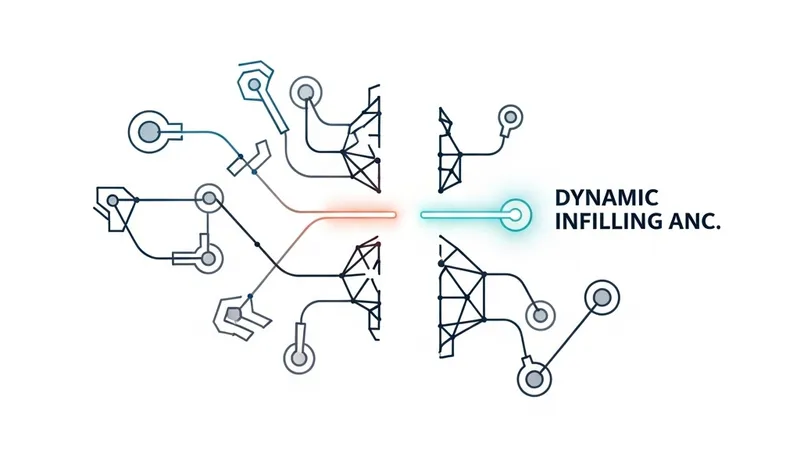
However, traditional methods enforce these formatting constraints using rigid, fixed-span anchors. This rigidity often leads to catastrophic failures: either truncating the reasoning chain prematurely or introducing massive redundant content. To overcome this limitation, researchers have proposed Dynamic Infilling Anchors (DIA), a training-free framework accepted at ACL 2026.
DIA functions as a training-free mechanism that dynamically estimates the optimal positions of end-anchors to adjust the generation length *before* starting the iterative infilling process. This flexible approach guarantees both structural correctness and semantic coherence without the inefficiencies of fixed-span techniques.
Evaluations on rigorous reasoning benchmarks like GSM8K and MATH demonstrate that DIA dramatically improves format compliance and task accuracy, achieving remarkable zero-shot improvements. This positions DIA as a highly robust pathway toward structure-aware, reliable generative modeling.
[AgentUpdate Depth Analysis] In the current AI Agent landscape, maintaining strict #format constraints (like parseable JSON for tool calling) is critical yet challenging. While autoregressive models rely on constrained decoding (e.g., grammar-based sampling) which often sacrifices reasoning capacity, Diffusion LLMs (dLLMs) offer a fresh paradigm with bidirectional attention. The introduction of Dynamic Infilling Anchors (DIA) solves the rigid length limitation of non-autoregressive generation without requiring costly retraining. For #AI Agents, this means the ability to plan and generate structured thoughts and API parameters globally and simultaneously. DIA-powered dLLMs could fundamentally accelerate agent workflows, transforming them from step-by-step token generation to highly parallelized, structure-aware execution, paving the way for faster and more reliable multi-agent orchestration.