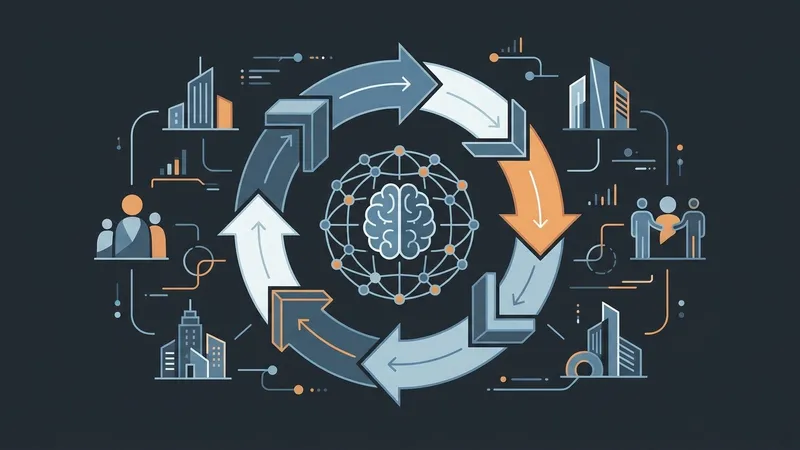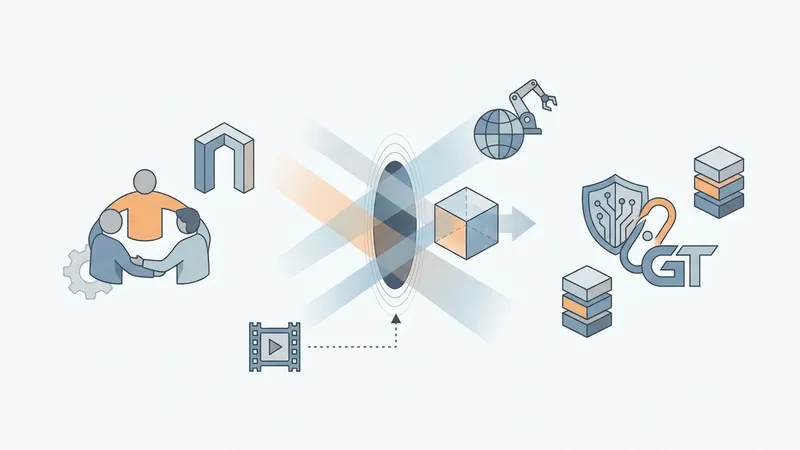
While Sim2Real has been the gold standard, the #robotics community is shifting focus toward Real2Sim. NVIDIA GEAR, in collaboration with Fei-Fei Li's team and Georgia Tech, has introduced SimFoundry, a system designed to streamline the transition from real-world perception to robotic simulation.
The core capability of #SimFoundry is its ability to generate interactive, evaluative simulation environments from a single RGB video. By moving beyond static 3D reconstruction, the system leverages a mechanism called "Digital Cousins" to intelligently vary objects, layouts, and tasks, effectively creating an infinite supply of synthetic training data.
The system operates through a three-stage pipeline: Extraction, Generation, and Augmentation. By utilizing Vision Language Models (VLM) and SAM 3, the pipeline parses scenes into assets compatible with physics engines like IsaacLab. Experimental results are compelling, showing a Pearson correlation of 0.911 in policy evaluation and a performance boost of up to 40% in real-world task success rates when training with augmented Digital Cousins.
[AgentUpdate Depth Analysis] SimFoundry represents a pivotal shift for embodied AI, moving from data scarcity to autonomous data generation. The primary bottleneck in agent development has always been the cost of real-world interaction data. Traditional simulation methods often fail due to the overhead of manual modeling. By closing the Real-to-Sim loop, SimFoundry provides a scalable solution that mirrors the pre-training paradigms seen in LLMs. Compared to existing simulation frameworks like NVIDIA Isaac Sim or standard rendering pipelines, SimFoundry excels in generalization and zero-shot transferability. This technological trajectory suggests that future AI Agents will transcend their roles as software-only assistants, evolving into entities capable of observing reality and automatically synthesizing the physical interaction data required to master it. For the broader AI Agent ecosystem, SimFoundry’s capability to transform raw video into high-fidelity physics-ready data serves as a fundamental infrastructure that will significantly accelerate the deployment of autonomous agents into real-world, complex environments.