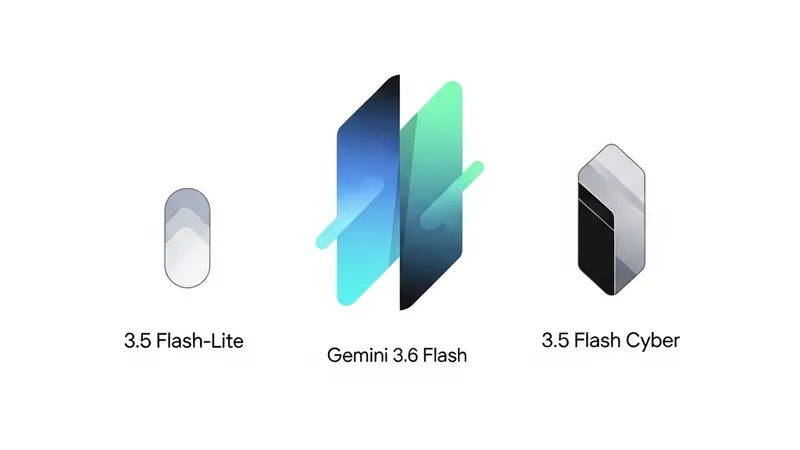
Despite recent social media skepticism, Google has launched a trio of new lightweight models: Gemini 3.6 Flash, 3.5 Flash-Lite, and the security-focused 3.5 Flash Cyber. Positioned as efficient, cost-effective engines "built for mass-scale AI agents," these models aim to address the operational and financial bottlenecks of deploying agentic workflows in the real world.
The flagship of this release, Gemini 3.6 Flash, is designed as a true "workhorse." According to data from Artificial Analysis, 3.6 Flash uses 17% fewer output tokens than 3.5 Flash, with savings reaching up to 65% in specialized code benchmarks like DeepSWE. This means fewer reasoning steps and redundant tool calls. #Google has also slashed prices, with input at $1.5/M tokens and output reduced from $9 to $7.5/M tokens, drastically lowering the cost per agent run.
In benchmarks, 3.6 Flash shines in coding and computer control. Its DeepSWE score improved from 37% to 49%, and the ML research-focused MLE Bench jumped from 49.7% to 63.9%. Its #computer-use capability (OSWorld-Verified) rose to 83% and is now built directly into the #Gemini API and enterprise offerings. Additionally, its knowledge cutoff has been advanced to March 2026, alongside upgraded Frontier Safety measures.
Meanwhile, 3.5 Flash-Lite target low-latency, high-throughput tasks, clocking an impressive 350 tokens/second. Priced at just $0.3/M input and $2.5/M output, it supports flexible "inference tiers" to scale reasoning complexity as needed. Intriguingly, this lightweight model outperforms the older 3.0 Flash on tasks like SWE-Bench Pro (54.2% vs 49.6%). For security, 3.5 Flash Cyber works alongside Google's CodeMender to patch software vulnerabilities, available in a restricted closed beta for trusted partners.
However, the highly anticipated flagship Gemini 3.5 Pro remains absent. Reports suggest its coding performance fell short of internal expectations, leading Google to potentially rewrite its training regimen. While Google's Logan Kilpatrick tried to pivot attention to "ambitious pre-training" for Gemini 4, critics note that while the new Flash models offer incredible cost efficiency, 3.6 Flash's raw intelligence score remains largely flat compared to 3.5 Flash.
[AgentUpdate Depth Analysis] Google's latest release reflects a pragmatic shift toward "Agent engineering" amid struggles to deliver its flagship Gemini 3.5 Pro. By drastically cutting token costs, optimizing multi-step reasoning efficiency, and introducing native "Computer Use" capabilities, Google is addressing the primary bottlenecks of AI Agent deployment: cost and latency. While Gemini 3.6 Flash does not show a massive leap in raw intelligence compared to its predecessor, its 17% to 65% token savings and flexible inference tiers make it highly competitive against the likes of Claude 3.5 Sonnet and GPT-4o in production environments. This release signals that the AI race is shifting from benchmarking brute-force capability to optimizing the economic and operational viability of multi-agent workflows, establishing a crucial foothold for Google in the enterprise agentic ecosystem.