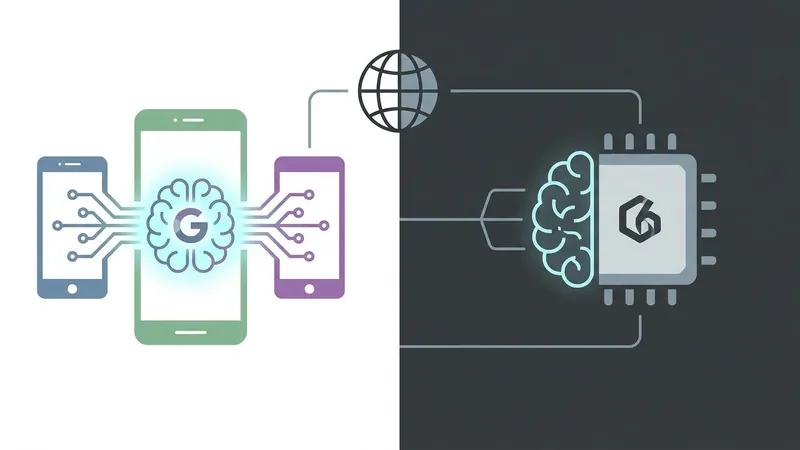
At its Made by Google 2026 event on Wednesday, the company unveiled the Pixel 11, Pixel 11 Pro, and Pixel 11 Pro XL. However, the launch wasn't merely about incremental hardware upgrades; instead, it was about positioning Gemini Intelligence as the core operating layer of the entire user experience, running seamlessly across apps, messages, calendars, maps, and other core features.
According to Google, the new lineup is built from the ground up for AI integration, powered by the next-generation Tensor G6 chip. This silicon is engineered to run the latest Gemini Nano model locally on-device, enabling significantly faster and more secure AI processing without relying constantly on the cloud.
The most significant shift is that Gemini is no longer confined to a passive chatbot interface. On the Pixel 11, it proactively surfaces context-aware cards. For instance, if you query an upcoming trip, #Gemini can pull flight details from Gmail, display real-time delays, and suggest actions like adding events to Google Calendar, saving locations to Google Maps, or storing membership numbers in Google Wallet.
Google is pushing Gemini deeper into the realm of agentic AI. Its advanced multi-step task capabilities can interact directly with third-party food delivery, grocery, and rideshare applications, allowing users to monitor, pause, or interrupt the autonomous workflow at any point. Additionally, Google introduced Rambler, an intelligent voice-input tool that easily handles natural, non-linear human speech—processing filler words like "um" and "ah" and mid-sentence corrections to deliver rapid, accurate actions.
The phone also features an array of AI-powered creative and media utilities, including Live Translate with new sign-language capabilities, Magic Capture for optimal photo composition, and the Creator Suite for on-device video production. Hardware-accelerated features like Instant Night Sight and direct integration of Circle to Search into the camera UI further underscore the device's computing power.
[AgentUpdate Depth Analysis] The launch of the Pixel 11 series represents a pivotal milestone in the transition of mobile devices from static carriers of applications to proactive, hardware-accelerated agentic AI hubs. By tightly pairing Tensor G6 with the on-device Gemini Nano model, Google is successfully demonstrating how context-rich personal data can be processed locally to execute complex, multi-step workflows without violating user privacy. While competitors like Apple are still refining their system-wide orchestrations, Google's deep integration of Gemini across its productivity suite and third-party app ecosystem gives it a distinct operational edge. For the global AI Agent ecosystem, this release proves that the future of mobile interfaces lies in proactive assistant cards rather than siloed apps, establishing local Small Language Models (SLMs) as the primary control plane for modern personal computing.