With the rise of multimodal AI, accurately evaluating the representation capabilities of non-speech audio—such as environmental sounds, musical instruments, and animal calls—has become a major challenge. Similar to MTEB in the text domain, Google Research has introduced MSEB (Multi-Task Sound Embedding Benchmark) to serve as a standardized evaluation platform for general-purpose sound encoders.
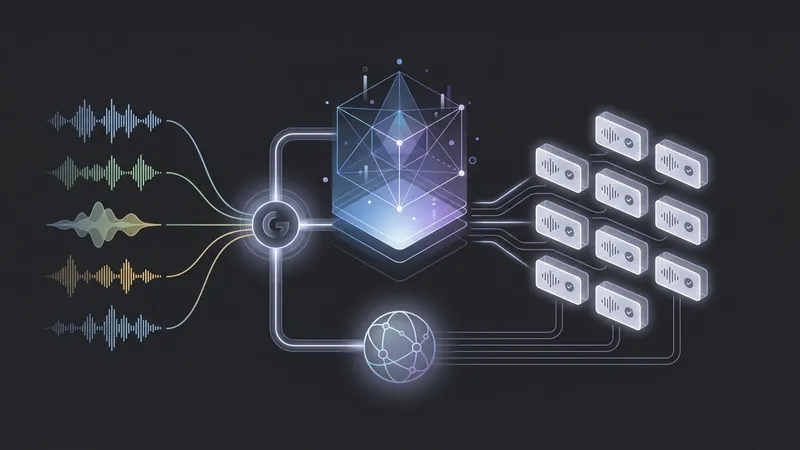
To evaluate a custom sound encoder on MSEB, developers must implement the benchmark's "API contract." This requires wrapping custom models in a unified interface that accepts raw audio waveforms (typically sampled at 16kHz or 32kHz) and outputs fixed-dimensional dense vectors. Popular models like AST (Audio Spectrogram Transformer) and CLAP can be easily wrapped and benchmarked using this standard.
Once integrated, MSEB scores the encoder across four primary task types: Classification (assessing linear probe or zero-shot capabilities), Clustering (testing unsupervised feature grouping), Retrieval (evaluating text-to-audio and audio-to-audio semantic search), and Segmentation (measuring temporal boundary detection). This multi-dimensional approach prevents models from overfitting to a single task and highlights encoders with true generalization capabilities.
[AgentUpdate Depth Analysis] Historically, AI Agents have operated with a sensory deficit, relying heavily on text transcriptions and missing vital environmental acoustic cues. Google's MSEB provides the essential benchmarking standard needed to develop robust "auditory cortexes" for next-generation AI Agents. Compared to isolated datasets like AudioSet, #MSEB's multi-task evaluation guarantees that sound representations are resilient enough for real-world deployment. For embodied AI and spatial computing agents, the ability to process raw soundscapes is crucial. Standardizing these encoders via MSEB enables agents to detect safety anomalies (like glass breaking) or recognize subtle environmental context in real-time, accelerating the shift of AI Agents from text-constrained assistants to fully context-aware, multimodal entities.