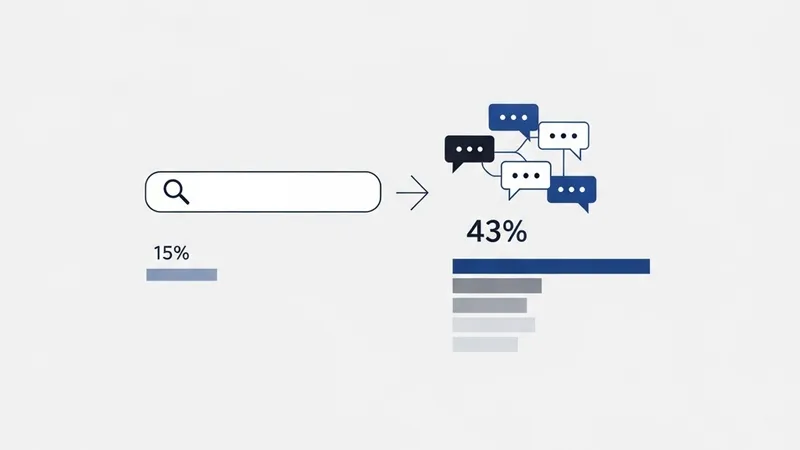
AI search is rapidly becoming the default, reshaping how users consume information. According to a new report from market intelligence firm Similarweb, #Google’s AI-generated answers in search, known as AI Overviews, have surged from appearing in 15% of searches to 43% in just a year's time.
What began as an AI layer on top of traditional search has now become an integral part of the user journey. Google now drops users into AI Overviews, where they can continue their research via Google’s more conversational AI Mode. Consequently, AI Mode visits rose from 126 million in June 2025 to 279 million by May 2026.
This data illustrates a shift from the era of "blue links" to one where Google itself is the final destination, sourcing answers directly from indexed websites. This increases user time on Google's platform. The average length of Google searches has also risen, suggesting that users are replacing short keyword queries with longer, natural conversational queries designed for AI.
This change has alarmed publishers losing out on referral traffic due to AI citations that do not yield clicks. In response, tech infrastructure provider Cloudflare introduced tools allowing publishers to block AI crawlers unless AI companies pay for content. Despite a fivefold increase in cited AI responses, only 6.8% of U.S. ChatGPT desktop queries included citations as of May 2026.
However, some hope remains. #ChatGPT's U.S. desktop referrals improved after a May 7 search update, with web traffic referrals more than doubling from 25% in March 2026 to nearly 60% by late May. This suggests users will click on prominent links when available. Nonetheless, the broader trend of Google transforming from a gateway to a destination remains clear.
[AgentUpdate Depth Analysis] Google's evolution from a traffic gateway to an "AI Destination" represents a profound paradigm shift for the AI Agent ecosystem. As search transitions to synthesize-and-present rather than index-and-redirect, Retrieval-Augmented Generation (#RAG) models are setting new defaults. For AI Agents, this evolution means that agentic workflows must shift away from merely routing traffic to synthesizing complex multi-source intelligence locally. This consolidation will force a major realignment in publisher monetization, steering the industry toward API-driven data licensing. For developers building autonomous agents, the challenge will be competing against integrated giant platforms by delivering superior proactive reasoning and hyper-personalized context that generalized AI search cannot replicate.