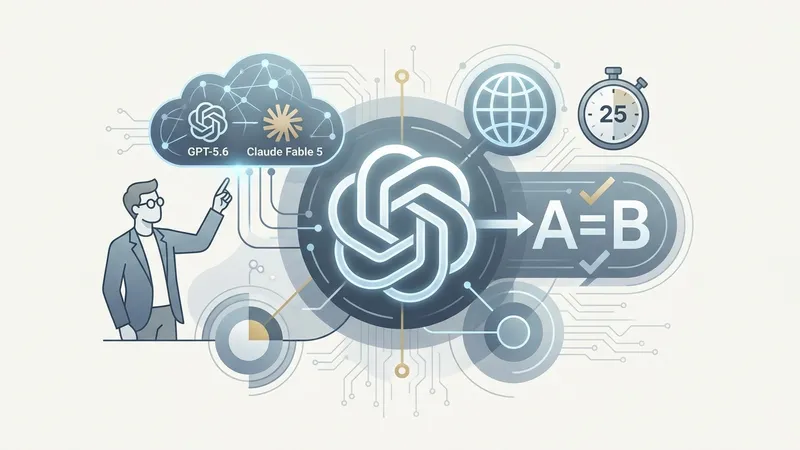
A classic 25-year-old mathematical hurdle in wireless communications has finally been resolved. Dimitris Papailiopoulos, a Lead Researcher at Microsoft Research, along with GPT-5.6 and Fable 5, has successfully proven a polynomial-time algorithm that allows MIMO detection to perfectly match the maximum likelihood threshold. The collaborative process took exactly seven days of intensive prompts and verification.
MIMO detection is a fundamental challenge in signal processing where a receiver must reconstruct N transmitted bits from a noisy, mixed-up signal. While exhaustive search (Maximum Likelihood) guarantees accuracy, its complexity scales exponentially at 2^N. Although proven NP-hard in the worst-case in 1989, practical random channels suggest that error-free recovery is statistically possible when the signal-to-noise ratio (SNR) reaches 2logN. For over two decades, researchers struggled to find a polynomial-time algorithm to reach this limit. The promising sphere decoder proposed in 2001 was disproven in 2005 as still being exponential. Subsequent approximations like semidefinite relaxation and AMP also failed to hit the precise 2logN limit.
The breakthrough was achieved by orchestrating two advanced LLMs. #GPT-5.6 proposed a path using Approximate Message Passing (AMP), while Fable 5 suggested a heuristically used but unproven 'signed LMMSE with greedy bit-flipping' approach. Dimitris pursued Fable’s route, using GPT-5.6 to audit and fix gaps. Through several iterations of having the models simplify each other's complex matrix formulations, they established a rigorous, readable proof. The final two-step algorithm—utilizing LMMSE rounding followed by greedy bit-flipping—guarantees exact recovery in polynomial complexity of O(N³) right at the theoretical threshold.
[AgentUpdate Depth Analysis] The collaborative breakthrough of GPT-5.6 and Fable 5 in solving a 25-year-old mathematical bottleneck marks a paradigm shift in AI-driven scientific discovery (AI for Science). Rather than acting as mere writing assistants, these LLMs functioned as autonomous cognitive agents in a multi-agent debate and refinement loop. By pitching different analytical paths (AMP vs. LMMSE with greedy flipping) against each other, and using one agent to audit and simplify the other's 'wall of symbols,' this workflow demonstrates the immense potential of Agentic workflows in tackling pure mathematics. Compared to traditional single-agent code-generation, this multi-agent collaborative reasoning mitigates hallucinations and handles complex, multi-layered deductive chains. As future agents integrate directly with formal verification tools like Lean, the AI Agent ecosystem will transition from simple task automation to pioneering foundational scientific breakthroughs.