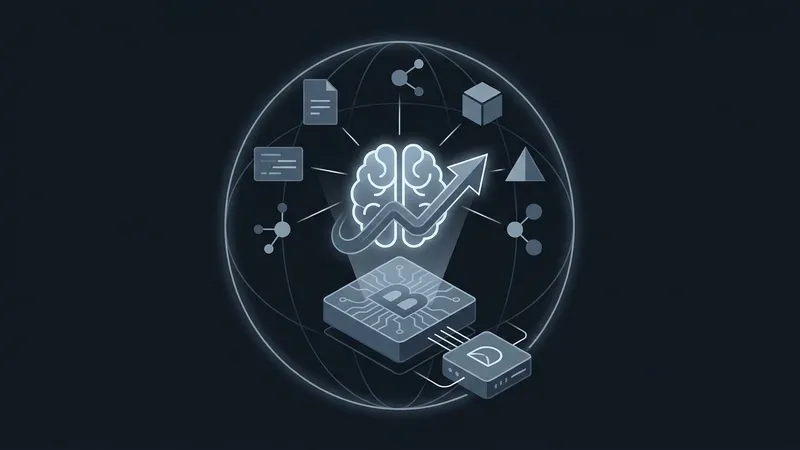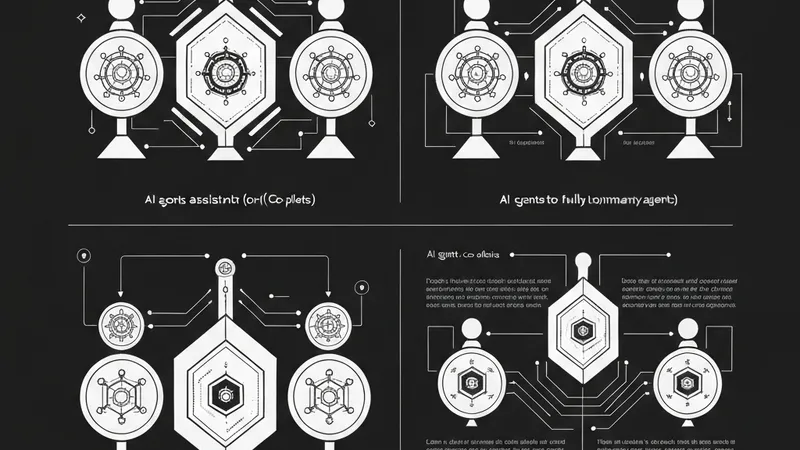
In recent years, the artificial intelligence landscape has been undergoing a paradigm shift from generative conversation to action-oriented execution. The spotlight has shifted from simple Q&A to AI Agents capable of independent planning, tool usage, and executing complex workflows, marking the transition from passive assistants to active executors.
Similar to the L1 to L5 levels of autonomous driving, AI agent #autonomy can be categorized into distinct tiers. Currently, most commercial systems remain in the "supervised autonomy" phase (akin to Level 2 or Level 3). For instance, Salesforce's Agentforce platform can autonomously handle customer support and lead qualification, but critical decisions still require a Human-in-the-Loop (HITL) mechanism to ensure compliance and accuracy.
Technical breakthroughs are accelerating this progression. Anthropic's release of the Computer Use capability, which allows models to interact with computer screens, move cursors, and type text just like humans, marks a major leap from API-bound agents to generalized UI control. Meanwhile, Microsoft's Copilot Studio is enhancing multi-step task orchestration, enabling agents to navigate uncertain environments autonomously.
However, achieving full autonomy still faces formidable hurdles. First is the reliability bottleneck: as task complexity and steps increase, the cumulative error rate of agents grows exponentially, often leading to infinite hallucination loops. Second is security and authorization: preventing agents from unauthorized actions during sensitive tasks (such as financial payments or data deletion) due to prompt injection remains a top enterprise concern.
[AgentUpdate Depth Analysis] Evaluating AI Agent autonomy requires looking not just at its capabilities, but at its fault tolerance. Today's AI Agents are transitioning from "LLM-only reasoning" to structured "cognitive architectures + environment sensing." Horizontally, #Anthropic's Computer Use represents an ambitious, generalized UI-driven approach, while Salesforce's #Agentforce excels in structured, API-driven enterprise workflows. The primary bottleneck preventing agents from reaching L4/L5 autonomy is no longer foundational model reasoning, but the lack of standardized "Agent-to-Environment" interaction protocols. Over the next 12 to 18 months, we expect the adoption of unified standards like the Model Context Protocol (MCP) to drastically reduce integration friction across heterogeneous systems, ultimately paving the way for multi-agent collaborative ecosystems.