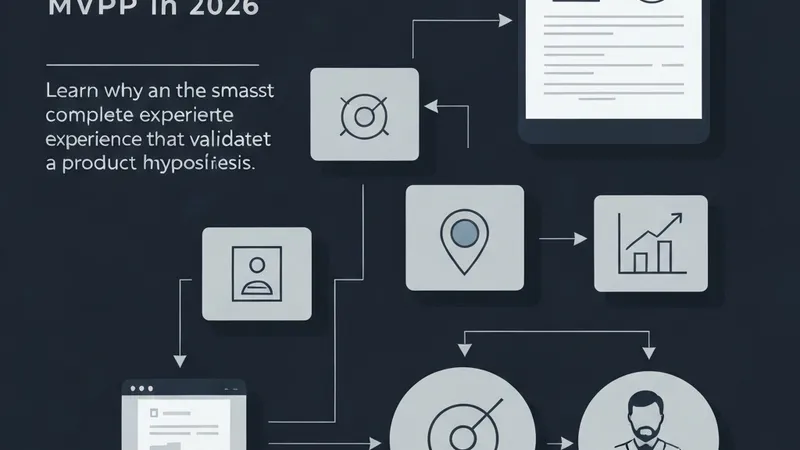
In 2026, a SaaS MVP is still frequently misunderstood. It is not a stripped-down, buggy version of your grand vision; rather, it is the smallest complete experience that proves users will pay to solve their core problem. Teams that internalize this reality ship in weeks, while others spend months polishing features nobody wants, only to discover at launch that their core assumption was wrong. The ultimate goal of an #MVP is to buy that invaluable user feedback early and cheaply.
A true MVP does one job exceptionally well end-to-end. It is not a prototype, a mockup, or a simple landing page with a waitlist—which only validate interest, not actual usage. To scope an MVP effectively, you must cut the scope (fewer features), but never the quality. If the core user loop is buggy or flaky, the first impression will be fatal. On the other hand, user reactions to missing nice-to-have features are actually high-value feature requests.
Start with a single Job to be Done (JTBD). Write it down as a single sentence: "When [situation], I want to [motivation], so I can [outcome]." If you cannot condense your product's core value into one sentence, your scope is too wide. Ask yourself: if only this single flow existed and worked perfectly, would anyone pay for it? If the honest answer is no, keep digging before writing a line of code.
Choose a technology stack that optimizes for speed, not architectural vanity. For most #SaaS products, a TypeScript front-end (such as Next.js or React), a PostgreSQL database, and a managed backend like Supabase or a lightweight NestJS API represent the gold standard. Avoid over-engineering with microservices or Kubernetes during this initial validation phase, as they solve scaling issues, not product-market fit.
[AgentUpdate Depth Analysis] In 2026, the proliferation of AI Agent technologies and AI-assisted coding tools like Cursor has drastically shortened the development cycle of a SaaS MVP from weeks to days. However, as the cost of software creation approaches zero, the value of the MVP shifts entirely from "the ability to build" to "the insight of what to build." AI Agents are not just writing the boilerplate; they are increasingly capable of acting as autonomous testers and early integrations themselves. In the emerging AI Agent ecosystem, SaaS products must be built with agent-interoperability in mind, potentially leveraging protocol-first designs like MCP (Model Context Protocol). Winning in this new paradigm requires founders to focus less on full-stack plumbing and more on defining high-value workflows that humans and AI Agents alike are eager to pay for.