Today, almost every product roadmap includes "add AI," yet most of these features will be quietly decommissioned within a year. This is not due to technological failure—as the tech works remarkably well—but because they were retrofitted for novelty rather than utility. Winning teams focus less on possessing the most advanced large language models (LLMs), and more on selecting the right job for the model and engineering around its inherent constraints. Integrating AI is less about models and more about product judgment.
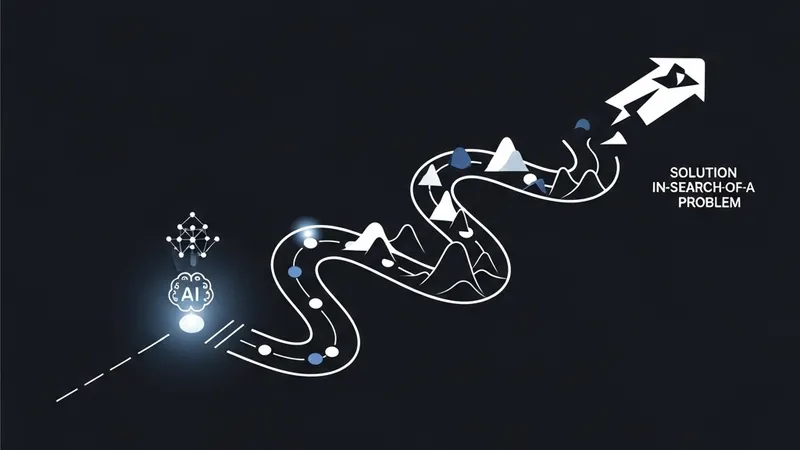
The default failure mode is building a solution in search of a problem—for instance, choosing GPT-4 or Claude first and then hunting for integration points. Instead, product teams must reverse this flow: identify where users experience friction, abandon flows, or stare at blank inputs, and evaluate if an LLM can genuinely alleviate that pain.
Excellent candidates for AI integration share distinct traits: unstructured inputs (like messy documents or free text), high tolerance for near-misses (where a "good enough" draft is highly useful and verifiable by users), and tedious human tasks. Ideal use cases include summarizing long threads, text extraction, or natural-language interfaces.
Conversely, avoid AI for deterministic tasks requiring exact precision. A simple regular expression, a lookup table, or a PostgreSQL query is cheaper, faster, and infinitely more debuggable than an #LLM. Senior engineering decisions often involve identifying which parts of a product should *not* use AI.
[AgentUpdate Depth Analysis] In the rapidly evolving AI Agent ecosystem, this "job-first, model-second" philosophy serves as a critical guiding principle. As orchestration frameworks like LangChain, CrewAI, and LlamaIndex lower the barrier to deploying multi-agent systems, developers frequently fall into the trap of over-engineering agentic workflows for simple deterministic tasks. The future of viable AI products lies not in pure generative autonomy, but in robust Workflow Engineering that cleanly delineates deterministic business logic from probabilistic LLM reasoning. By grounding agents in high-tolerance, unstructured data extraction and natural language interfaces while relying on traditional APIs for exact computations, builders can construct resilient, production-grade applications. This hybrid design paradigm will ultimately define the winners of the next-generation agent economy.