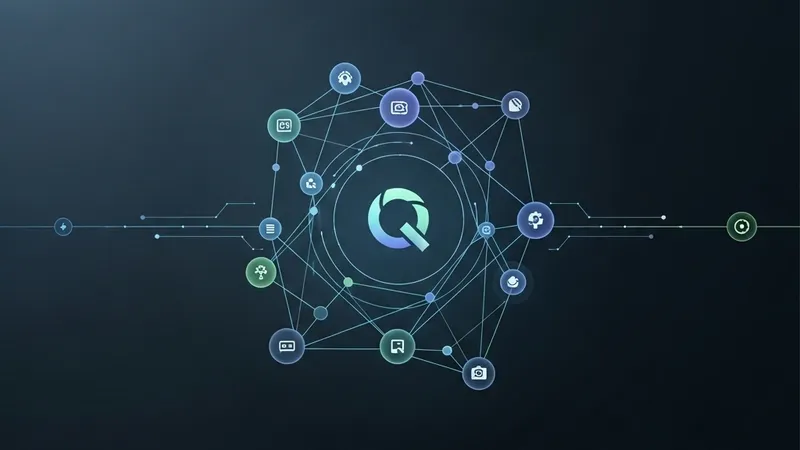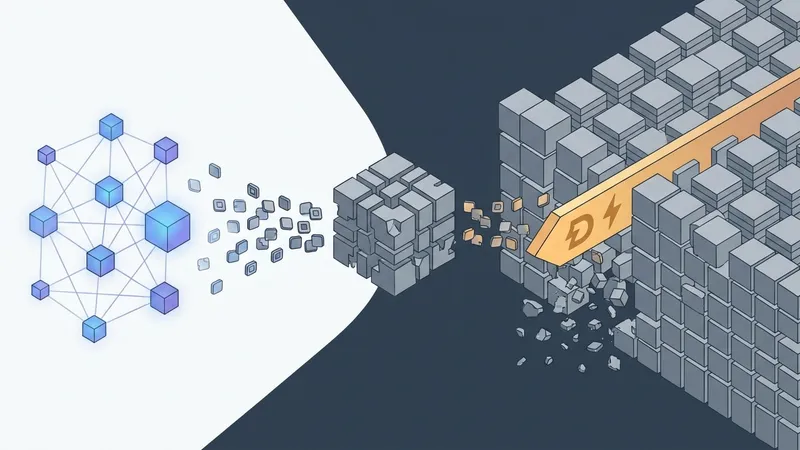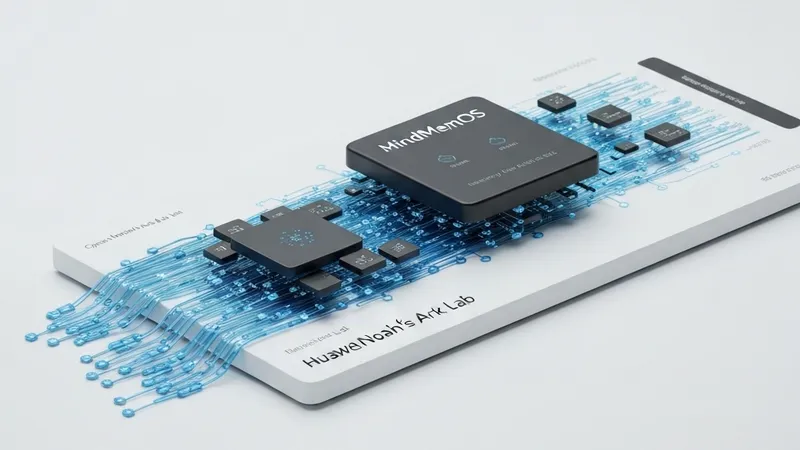
While AI Agents are growing increasingly powerful, users still face a major bottleneck: memory is volatile and non-transferable across different agents or sessions. To bridge this gap, Huawei Noah's Ark Lab has open-sourced MindMemOS, a transferable and self-evolving memory operating layer for AI Agents designed to address critical issues like non-transferability, rigid schemas, lack of evolution, and missing temporal dimensions.
Unlike traditional systems storing memory as flat text chunks or vector embeddings, MindMemOS reconstructs memory using an Entity-Property-Time 3D structure. Entities represent persistent objects; Properties capture facts and user preferences; Time tracks the evolution of these properties. This allows the system to organize knowledge on a continuous timeline instead of treating past and present facts as isolated events.
The framework has set new benchmarks: achieving a score of 94.03 on LoCoMo and 70.63% on PersonaMem. In the Fact Consolidation test of MemoryAgentBench, its offline consolidation compressed active memories by 19.4% to 23.5% while boosting QA accuracy by up to 10.3%. Furthermore, trajectory-based skill evolution pushed the task success rate on SpreadsheetBench-Verified to 57.2%±2.4%.
For memory ingestion, MindMemOS provides two complementary pipelines: MindVanilla for open-domain information ingestion, and MindSchema which utilizes pre-defined models for domain-specific extractions. During retrieval, a unique Compact Search mechanism uses an outer agentic module to plan search paths and inner tools to execute multi-hop reasoning, finding the most informative context.
To ensure continuous growth, the system employs Dreaming and Feedback loops. Dreaming runs offline to consolidate redundant data, resolve contradictions, and archive expired facts, saving real-time LLM reasoning costs. Feedback integrates both explicit and implicit user corrections into the memory layer. Together, these mechanisms allow the memory layer and Agent skills to evolve in unison.
[AgentUpdate Depth Analysis] Historically, AI Agent memory has suffered from static vector storage (RAG) or tightly-bound runtime contexts, exemplified by systems like MemGPT. MindMemOS redefines this landscape by decoupling memory into a standardized, transferable, and self-evolving "Entity-Property-Time" 3D operating layer. Its "Dreaming" phase mirrors human cognitive consolidation, converting online experiences into optimized offline knowledge. This architecture profoundly impacts the AI Agent ecosystem. By standardizing memory representations across heterogeneous agents and frameworks, #MindMemOS paves the way for seamless multi-agent collaboration and persistent digital twins. Furthermore, moving cognitive consolidation to offline batches drastically lowers online inference costs and context window pressures, addressing a major commercial barrier. MindMemOS marks a pivotal step toward a unified, persistent memory layer for future Agent OS designs.