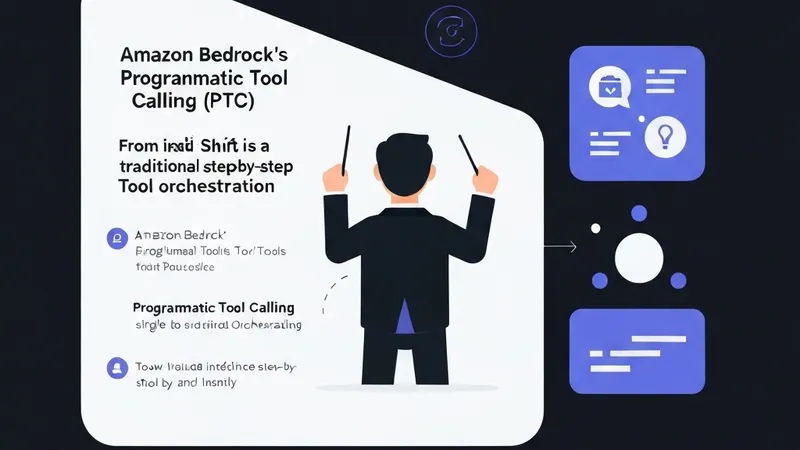
Programmatic tool calling (PTC) represents a paradigm shift in how large language models (LLMs) interact with external tools. In traditional tool-calling workflows, each tool invocation requires a full round trip back to the model: the model calls a tool, receives the result, reasons, and then calls the next tool. For workflows with multiple tool calls, this creates compounding latency and token consumption, as every intermediate result must pass through the model’s context window.
PTC takes a different approach. Instead of orchestrating tool calls one at a time, the model writes code (typically Python) that invokes multiple tools programmatically within a sandboxed execution environment. This code can handle loops, conditionals, filtering, and aggregation. The model is sampled only once to generate the code. The execution environment then handles all tool invocations, and only the final processed result returns to the model's context. This drastically reduces latency and token usage, making PTC highly effective for large-scale data processing, precise numerical computations, multi-step orchestration, and privacy-sensitive scenarios where raw data shouldn't enter the context window.
Although PTC originated as a provider-specific feature, its underlying pattern—model generates code, sandbox executes it, only final output returns—is model-agnostic. In this post, we demonstrate three ways to implement PTC on Amazon Bedrock: 1) a self-hosted Docker sandbox on ECS for maximum control; 2) a managed solution using Amazon Bedrock AgentCore Code Interpreter; and 3) an Anthropic SDK-compatible path via a proxy for specific developer experiences.
To understand the bottleneck of traditional tool calling, consider this query: "Which engineering team members exceeded their Q3 travel budget?" In a traditional setup, the model must make sequential calls: one call to list 20 team members, 20 separate calls to get expense records for each person (returning 50-100 items each), and further calls for budget thresholds. Over 2,000 expense records enter the context window for the model to filter and summarize. This sequential pattern leads to extreme token wastage and high latency due to multiple inference cycles.
[AgentUpdate Depth Analysis] Programmatic Tool Calling (PTC) marks a major transition for AI Agents from "reactive orchestration" to "active compilation." While traditional ReAct loops treat the LLM as a step-by-step state machine—suffering under data-intensive, multi-step tasks—PTC leverages "Code-as-Control-Flow" to offload loops and conditionals to an execution sandbox. This decouples heavy reasoning from repetitive network round-trips. Similar to OpenAI's Code Interpreter, PTC establishes sandboxed computation as a core infrastructure for modern LLMs. Amazon Bedrock's support for multiple PTC implementation paths—ranging from ECS self-hosting to managed Code Interpreters—significantly lowers the barrier for enterprises. This pattern is poised to become the standard for building reliable, low-latency, and cost-effective enterprise AI Agents.