Chinese AI unicorn Moonshot AI released a new version of its Kimi K3 model this week, leading to a perhaps-inevitable wave of global discourse about China, geopolitics, and open-source AI.
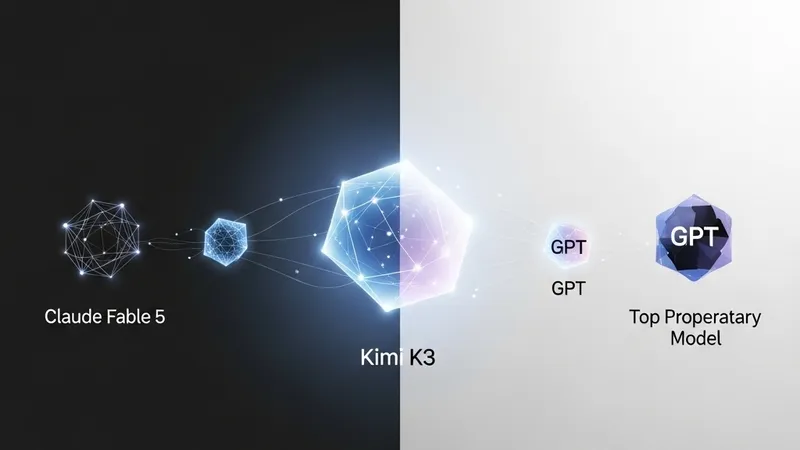
Moonshot AI stated that while #Kimi K3 "still trails the most powerful proprietary models, Claude Fable 5 and GPT 5.6 Sol," the new open-source model "demonstrated frontier-level performance across our evaluation suite, consistently outperforming other tested models." Independent evaluations from Arena.ai and Vals AI also suggested that Kimi K3 is highly competitive with flagship proprietary models.
The announcement, which coincided with the World AI Conference in Shanghai, spooked Wall Street, with the Nasdaq dropping about 1% as investors sold off semiconductor stocks like Nvidia.
The resulting posts from US tech industry figures closely mirror the heated debate that followed DeepSeek R1's open-source release in January 2025. However, the stakes are now much higher amidst the ongoing tariff tensions, national security concerns over companies like Anthropic, and looming AI IPOs.
David Sacks, the former AI czar and co-chair of the President's Council of Advisors on Science and Technology, contrasted Kimi’s progress with a United States that is "tying itself in knots: politicians and bureaucrats are banning new data centers, piling on state regulations, and pushing for new federal agencies to pre-approve frontier models. This is how you lose the AI race." Sacks also took the opportunity to label Claude as a "woke, lobotomized model" hurting American competitiveness.
Meanwhile, former Uber CEO Travis Kalanick complained that Chinese developers are "distilling off" (training on the outputs of) American frontier models. "If distillation isn't enforced against, then everyone should be able to distill from everyone else," Kalanick argued, though industry observers point out that American models have also leveraged Chinese models like Kimi in their training loops.
OpenAI's head of strategic futures, Dean Ball, offered a different perspective, calling Kimi K3 "a very good model" whose performance cannot be "explained away by distillation." Ball added that he is "personally surprised the Chinese state continues to allow the open-sourcing of models this good, given potential risks."
Ball went on to suggest that the logical conclusion of an #open-weight-dominated world is "full AI communism," where AI is treated as a "public good" provided by the state as "digital public infrastructure." Ball described this future as a "dystopian hellscape," noting that open-weight advocates rarely reject this potential outcome.
[AgentUpdate Depth Analysis] The emergence of frontier-class open-weight models like Kimi K3 represents a critical inflection point for the AI Agent ecosystem. Historically, agentic workflows—which require complex planning, long-context reasoning, and robust tool-calling—have been tethered to expensive, proprietary APIs. By making "frontier-level" intelligence open-weight, Kimi K3 allows developers to run high-performance Agent Cores locally, enabling deep customization and cost-effective fine-tuning without data privacy concerns. This shifts the ecosystem away from centralized proprietary monopolies toward open, distributed agent frameworks. Furthermore, the debate over "AI as public infrastructure" highlights a future where fundamental agent intelligence becomes democratized, paving the way for standard interoperability protocols like MCP to scale exponentially across diverse, decentralized environments.