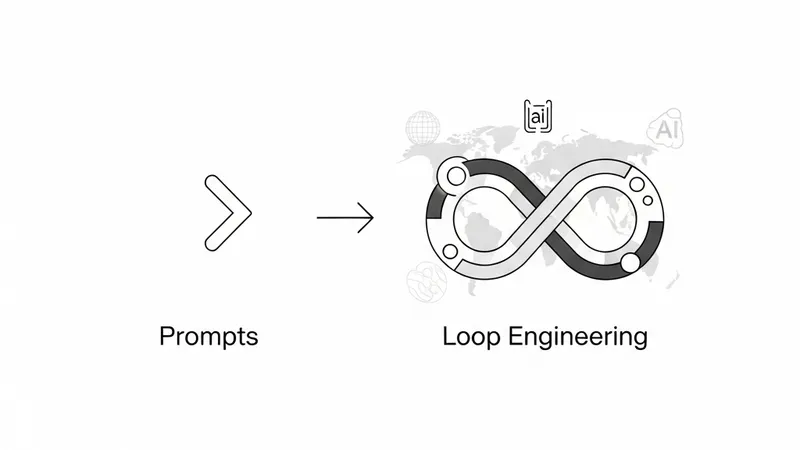
In the landscape of AI interaction, the traditional focus on prompts is rapidly shifting toward Loop Engineering. Rather than manually prompting models step-by-step, developers are designing feedback loop systems where AI executes, inspects, and self-corrects. This paradigm shift forms the core logic of the current AI Agent era, turning humans from prompters into system architects.
However, execution loops alone do not guarantee understanding. To enable AI agents to continuously reason, correct, and model the environments they interact with, Chinese AI startup FaceMind Research Asia introduced Looped World Models (LoopWM). The paper quickly topped the Hugging Face Papers daily chart, sparking broad discussions across the AI community.
Founded by PhD Hongyuan Lu and Yiran Wei, FaceMind has secured tens of millions of RMB in Pre-A funding from StarLink Capital, 360 Group, and Lu Qi's MiraclePlus. The team's prior work on "Adam's Law" previously garnered attention and validation from Anthropic. World models are widely considered foundational for GUI Agents, embodied AI, and robotics, as they provide stable predictions during long-horizon tasks and interface understanding.
What core technical bottleneck does LoopWM address? High-fidelity, long-horizon environment simulation historically required massive computation depths. Yet, stacking deeper networks leads to prohibitive deployment costs and catastrophic compounding errors that derail the entire simulation. LoopWM bypasses this by utilizing parameter-shared Transformer blocks to repeatedly refine the same latent state (potential state representation) in a loop, rather than introducing new parameter layers.
This novel approach establishes a new scaling axis: iterative latent depth refinement. Simple tasks require fewer iterations, while complex scenarios trigger more recursive passes, enabling computation depth to scale dynamically based on task difficulty. This parameter-efficient architecture optimizes both calculation depth and model size, providing a highly promising infrastructure for future AI systems.
[AgentUpdate Depth Analysis] The evolution from static prompts to dynamic loops represents a major advancement in agent autonomy. However, contemporary AI agents are often limited by fragile heuristic rules and high API latency. #FaceMind's #LoopWM tackles this bottleneck by enabling a world model that scales its computational depth dynamically. By refining the latent state using shared-parameter Transformers rather than brute-force deeper architectures, LoopWM offers a computationally efficient way to run long-horizon simulations without compounding errors. For the broader AI Agent ecosystem, this is a massive leap forward. It suggests that future GUI and embodied agents won't just blindly execute loops; they will run highly-efficient internal simulations to 'think' and predict the consequences of their actions before execution. This marks a critical step toward resilient, autonomous, and cost-effective OS-level and robotic agents.