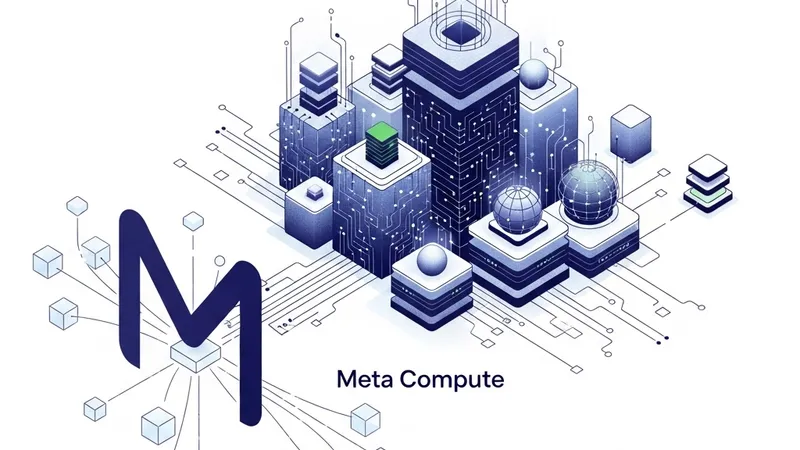
Facing bottlenecks in in-house frontier model development, Meta CEO Mark Zuckerberg is shifting strategic focus to AI infrastructure. According to Bloomberg, amid limited access to Gemini and slower-than-expected progress in internal AI Agent technologies, Meta is considering the launch of Meta Compute, a cloud-like service aiming to lease its massive GPU infrastructure to third-party enterprises.
Data from SemiAnalysis indicates that Meta's capital expenditure on data centers and chip sourcing is accelerating. In the first half of 2024 alone, Meta secured over 5GW of capacity in cloud and leased data centers. Combining this with its rapid self-built data center expansion, Meta has committed to nearly 10GW of datacenter power since the beginning of 2024. Its two largest proprietary data center campuses under construction account for 2.5GW of capacity.
This massive compute pool will serve four primary purposes: training proprietary models like Muse Spark and the upcoming Watermelon under MSL; increasing the complexity of its advertisement recommendation systems by 10x; offering flexible, short-term compute leasing similar to SpaceX's dynamic leasing model; and acting as a managed model hosting platform comparable to Amazon Bedrock or Google Vertex.
Furthermore, Meta is reportedly in advanced discussions with Anthropic to secure private instance access to Claude. This move will bypass the loss of Google Gemini, providing Meta's internal projects with high-quality tokens while enabling Meta to resell Claude as a service. It also allows Meta to build vertical marketing SaaS apps powered by frontier AI Agents. This strategic shift places Meta in direct competition not only with AWS and Azure but also specialized neoclouds like CoreWeave and Nebius.
The pivot highlights the skyrocketing cost of frontier LLM R&D. Meta's 2026 capital expenditure guidance has been adjusted upwards to $125B–$145B. Although the open-source Llama series has broad adoption, direct monetization remains elusive. Meta is betting big on its next-generation model, Watermelon, which reportedly consumes an order of magnitude more compute than its predecessor, aimed at matching GPT-5.5 capabilities with a specific focus on coding and agentic workflows.
[AgentUpdate Depth Analysis] Meta's entry into the compute-leasing market via Meta Compute represents a profound paradigm shift in the AI Agent ecosystem. By transforming raw GPUs into utility-like compute-as-a-service, Meta is systematically lowering the economic barrier for running complex, multi-agent frameworks at scale. The hosting of #Anthropic's Claude highlights a hybrid future where model intelligence is decoupled from the underlying hardware provider. For AI Agents, the critical unlock lies in Meta's capability to natively fuse frontier models with its dominant distribution channel (Facebook, Instagram, WhatsApp). This will catalyze the transition of AI Agents from isolated chatbots into context-aware, autonomous business pipelines that can execute transaction flows directly within Meta’s social and SaaS infrastructure, accelerating the monetization of agentic workflows.