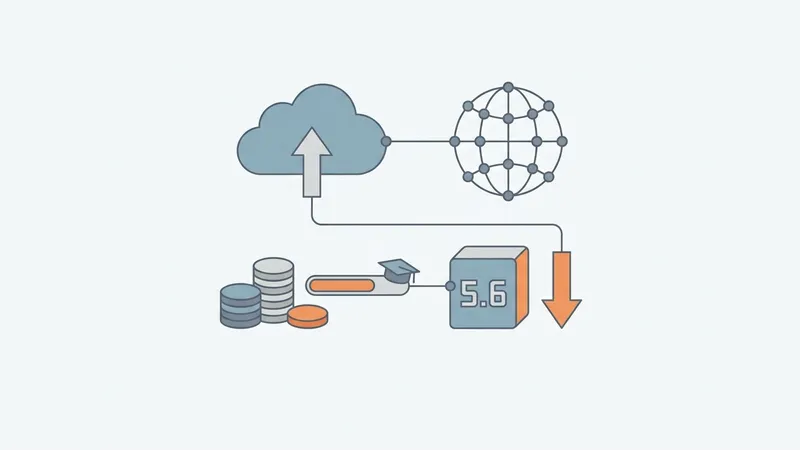
Even tech giant Microsoft is starting to feel the pinch of LLM token costs. According to internal emails, #Microsoft has officially instituted "AI token budget targets" for its business departments starting this July. Furthermore, GPT-5.6 has been designated as the default internal model due to its significantly lower cost. Microsoft Executive Vice President Jay Parikh stated internally: "Tokenmaxxing is not what we are optimizing for."
The new directive outlines three key measures: first, setting token budgets across business units; second, enhancing transparency by allowing employees to monitor their individual AI token spending (with internal data showing many engineers spending hundreds to thousands of dollars monthly); and third, switching default models to the more economical GPT-5.6. Parikh urged employees to "manage token spend like any other critical resource" and remain mindful of costs while leveraging GitHub Copilot.
This shift comes as no surprise. Microsoft CEO Satya Nadella previously admitted to being a "tokenmaxxer" himself, but noted that marginal productivity gains must justify marginal token costs. He realized that not every minor query warrants the most powerful and expensive frontier models. However, Microsoft employees have voiced strong discontent, with one asking: "If the company hosting the AI infrastructure can't afford its own products, how can normal enterprises?"
The "Tokenmaxxing" trend gained traction in Silicon Valley over recent months, with companies like Meta, OpenAI, and Amazon leveraging LLM usage as internal KPIs. Amazon launched and quickly shut down "KiroRank," a leaderboard that prompted engineers to burn tokens on low-value tasks just to game the system. Meta saw unofficial rankings like Claudeonomics track AI usage among 85,000 employees. Even Nvidia CEO Jensen Huang championed the trend, suggesting companies double down on token budgets for developers. However, rewarding pure consumption quickly inflated a massive financial bubble.
Runaway AI bills quickly forced enterprises to backtrack. Atlassian's monthly AI expenditure tripled to over $15 million in under a year, while Uber depleted its entire 2026 AI coding budget by April, forcing a $1,500 monthly limit per employee on tools like Cursor. Beyond ballooning costs, reliance on AI coding has triggered concerns about developer skill rot and unsafe, unaudited codebases. Consequently, companies like Citi and Adobe are dropping unlimited access, shifting metrics from token consumption to actual AI-driven business impact.
[AgentUpdate Depth Analysis] The rapid transition from "Tokenmaxxing" frenzy to strict corporate budgeting signals a crucial maturity phase in generative AI: moving from speculative experimentation to rigorous ROI justification. For the AI Agent ecosystem, this cost-conscious pivot will accelerate the adoption of "cost-aware" multi-agent routing systems, driving a shift away from massive monolithic LLMs toward lightweight, specialized, and edge-deployed models. For developers building AI agent frameworks, this is a clear signal that brute-force prompting with massive contexts is unsustainable. Future competitive moats will lie in advanced retrieval techniques, token compression algorithms, and stateful workflow orchestration. Ultimately, the industry must redefine the benchmark of AI success—shifting from how many tokens an Agent can consume to how much measurable business value it actually delivers.