Nearly a decade after co-authoring pioneering computer vision works like ResNet and Faster R-CNN, AI pioneer Shaoqing Ren has returned with a landmark autonomous driving paper. Serving as the corresponding author, Ren and researchers from NIO published "MM-Future: Multi-Mode Joint World–Action Modeling for Autonomous Driving," introducing a novel multi-mode world-action model designed to empower autonomous vehicles with proactive, multi-step planning capabilities.
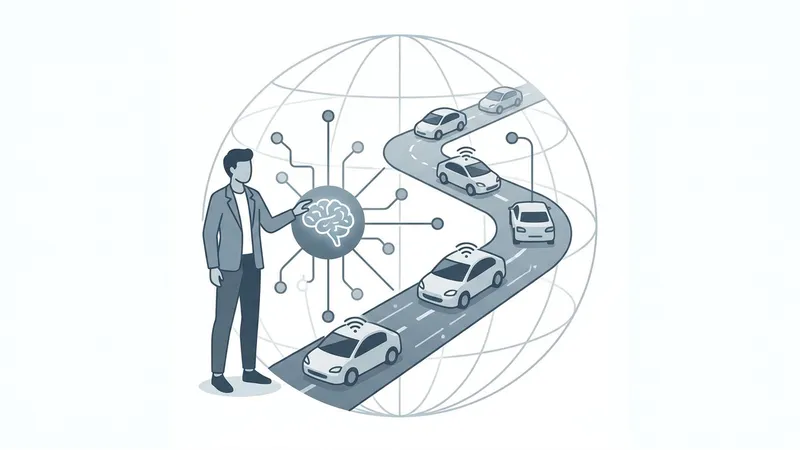
The research targets a fundamental limitation in end-to-end autonomous driving: in real-world scenarios, a vehicle cannot rely on a single deterministic trajectory but must navigate multiple uncertain futures. MM-Future addresses this by simultaneously generating multiple "paired scene-action hypotheses." In each hypothesis, the ego-vehicle's trajectory and the surrounding environment co-evolve interactively, allowing the system to evaluate diverse potential outcomes and select the safest, most efficient path.
Existing World–Action Models generally follow two flawed paradigms. Cascaded methods predict scenes and actions sequentially, creating a unidirectional information flow where downstream errors cannot correct upstream decisions. Conversely, joint methods enable bidirectional interaction but are typically limited to generating a single outcome. Real-world driving demands both bidirectional coupling and multi-hypothesis simulation, a critical technical gap filled by MM-Future.
To simulate dozens of futures simultaneously, MM-Future overcomes three main hurdles: diversity, computational cost, and candidate filtering. For diversity, the team applied Gaussian Mixture Noise to action priors and utilized a Best-of-Many supervision strategy during training. This prevents candidates from collapsing into a single ground-truth trajectory, preserving realistic variation in paired scene-action outputs.
To keep computational costs in check, the paper introduces MM-Tokens—compact visual representations compressed from multi-camera, multi-frame inputs. Instead of heavy RGB video reconstruction or full BEV generation, these tokens focus solely on planning-relevant semantics like road structures and surrounding dynamic actors. The co-evolution of actions and scenes is managed by a modality-aware Transformer, with the final selection executed by a Future-Conditioned Proposal Scorer that evaluates each trajectory based strictly on its matched future simulation.
Evaluation on the rigorous NAVSIM and HUGSIM benchmarks validated MM-Future's superior performance. On NAVSIM-v1, it achieved a top score of 94.0 PDMS, outperforming the WAM model DriveFuture (90.7) and the end-to-end model DrivoR (93.7). Ablation studies showed that scaling from a single-mode baseline (84.1) to 32 joint scene-action modes with future-conditioned scoring pushed the PDMS metric to 93.3, proving the immense value of multi-hypothesis co-evolution.
[AgentUpdate Depth Analysis] From the perspective of the AI Agent ecosystem, MM-Future is more than just an autonomous driving breakthrough; it represents a paradigm shift in Embodied AI world models. Unlike traditional Agents reliant on unidirectional reasoning, MM-Future achieves proactive planning through bidirectional action-scene co-evolution. This mirrors the Tree-of-Thought (ToT) and Monte Carlo Tree Search (MCTS) methodologies popular in LLM Agents, but translates them into a continuous, real-time physical space. By compressing high-dimensional sensory inputs into compact MM-Tokens, it scales parallel hypotheses without prohibitive computational overhead. This offers an elegant engineering solution to the critical "hallucination" and safety redundancy challenges of physical Agents. Ultimately, such joint world-action modeling will likely transcend self-driving, serving as the core decision-making framework for next-generation robotics and embodied intelligent systems.