Robots can now continuously grow just like software Coding Agents. NVIDIA has recently open-sourced ASPIRE (Agentic Skill Programming through Iterative Robot Exploration), a framework that allows robots to learn from failure, debug their own execution logs, and accumulate a reusable skills library. This represents a major paradigm shift in how embodied AI agents learn and operate.
According to #NVIDIA's prominent AI scientist Jim Fan, #ASPIRE marks a transition in robot training. In this new paradigm, training evolves from traditional gradient descent to 'Skill Refinement.' The resulting output is no longer a set of opaque neural network weights, but a continuously expanding 'Sensorimotor Skills Library.' Furthermore, distributed training transforms into multiple autonomous agents practicing diverse skills and contributing their localized experiences into a shared, centralized repository.
At the core of ASPIRE is the Code as Policy approach. Instead of directly outputting low-level joint actions via end-to-end VLA models, the LLM generates executable robot control programs that orchestrate perception, planning, and control APIs. ASPIRE solves Code as Policy's two historically critical limitations: the lack of precise multi-modal failure diagnostics and the inability to retain memory of successful debugging. By processing execution logs and visual trajectories through GPT or Claude, ASPIRE identifies bugs, revises the program, and packages the corrected logic into reusable, abstract skills.
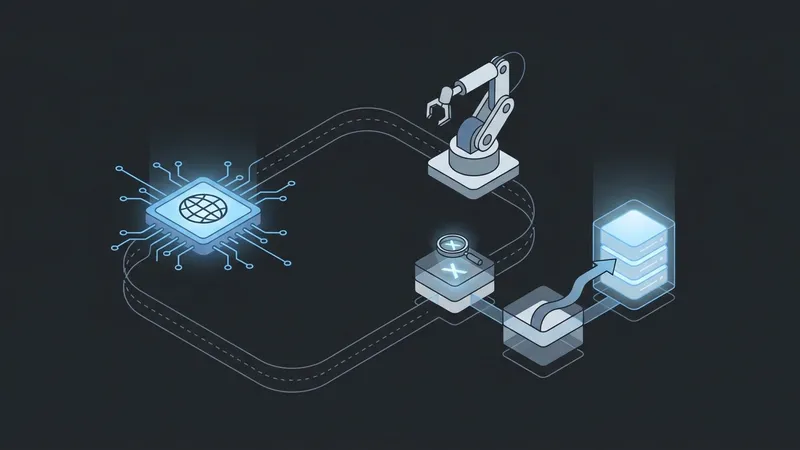
The ASPIRE architecture consists of a three-stage pipeline: First, the **robot execution engine** tracks every API call, sensor input, and visual evidence, functioning like a black-box recorder. Second, the **skills library** stores highly actionable 'debugging notes' (such as filtering false detections or attempting collision-free approaches from multiple angles). Third, an **evolutionary search** generates multiple program candidates to test in the environment, iteratively improving code based on real-world execution.
Across benchmark tests like Robosuite, ASPIRE dramatically outperformed baseline methods. In the highly complex bimanual object handover task, ASPIRE boosted the success rate from a meager 20% to an impressive 92%.
[AgentUpdate Depth Analysis] ASPIRE marks a monumental shift where software engineering practices meet physical embodied AI. Traditional robotic learning suffers from opaque black-box weight updates and high-cost physical trials. By using code as the medium, ASPIRE imports the classic 'write-test-debug' agentic loop into physical tasks. This code-centric skills framework dramatically elevates the debuggability of robot execution. More importantly, it natively supports decentralized, multi-agent knowledge synthesis, offering a scalable path for generalist embodied AI. In the long run, this signals that AI agents will evolve past digital interfaces, carrying self-improving software pipelines into the physical world for true lifelong learning.