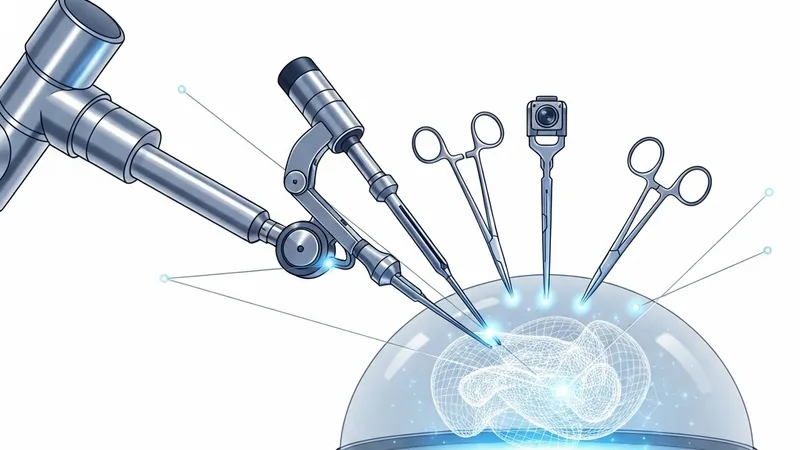
Surgical #robotics is rapidly moving from teleoperation toward capable vision-language-action (VLA) policies. However, evaluating and training these systems remains highly challenging. Physical robotic platforms are expensive to operate, experiments are slow to reproduce, and failures can damage instruments or biological material. Conventional simulators struggle to model complex surgical scenes containing deformable tissue, specular surfaces, sutures, needles, smoke, and occlusions.
World foundation models offer a different path by learning visual dynamics directly from synchronized video and robot kinematics. Built on NVIDIA Cosmos-Predict2.5-2B and post-trained on the Open-H-Embodiment dataset, Cosmos-H-Surgical-Simulator generates future surgical video based on actions, enabling offline policy evaluation and synthetic data generation.
Today, NVIDIA introduces Cosmos-H-Dreams, a real-time, action-conditioned generative simulator for surgical robotics. Powered by FlashDreams, NVIDIA's accelerated streaming-inference library, it distills the original model into a causal, few-step student model. Running on a single NVIDIA RTX PRO 6000 GPU, it provides an interactive, closed-loop control environment specialized for da Vinci Research Kit (dVRK) tabletop suturing, generating the next frames autoregressively.
[AgentUpdate Depth Analysis] Cosmos-H-Dreams represents a landmark shift for AI Agents operating in complex, high-stakes physical domains. Traditional reinforcement learning agents rely heavily on rigid physics engines, which struggle to simulate deformable surgical environments. By replacing explicit physical #simulation with a generative 'World Model' and distilling it for single-GPU real-time performance, NVIDIA establishes a viable closed-loop training pipeline. This 'Generative Simulation' paradigm bypasses the traditional Sim2Real gap by training agents directly on photorealistic visual dynamics. This breakthrough will likely accelerate deployment not only in surgical robotics, but across humanoid robotics, autonomous vehicles, and automated manufacturing, highlighting the crucial role of real-time world models in the future of the embodied AI agent ecosystem.