If you regularly pair-program with an AI coding agent, you have likely experienced this frustration: every time a new session starts, the context is completely wiped out. The agent has to re-discover auth flows, re-evaluate architectural decisions, and re-read files to reconstruct a mental model you already aligned on yesterday. Crucial project knowledge—such as system architectures, runbooks, and critical constraints—is scattered across corporate wikis, code comments, and developers' heads. None of it travels alongside the code, and none survives a fresh context window.
While files like `#CLAUDE.md` offer a partial solution for standing instructions, they are injected wholesale into every prompt, quickly exhausting token limits. On the other hand, auto-#memory features capture implicitly what an agent learns, but remain vendor-locked, proprietary, and unreviewed by humans. Corporate wikis are designed for humans and require complex exports. There is a clear gap: curated, structured team knowledge that is versioned directly with the code and readily accessible to both humans and agents.
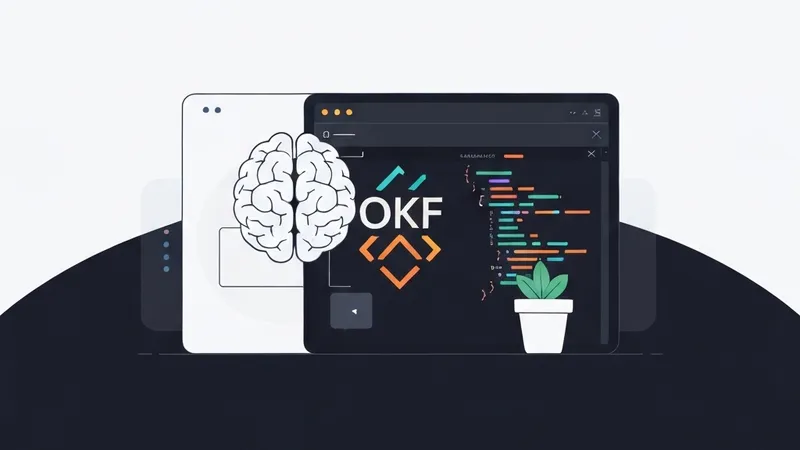
Enter Open Knowledge Format (#OKF), an open, vendor-neutral standard announced by the Google Cloud Data Cloud team in June 2026 under the Apache-2.0 license. The philosophy is remarkably simple: organize knowledge in a directory of standard Markdown files accompanied by YAML frontmatter. There is no complex schema registry, no heavy runtime, and no proprietary SDK. If you can use `cat` to read a file, or `git clone` a repository, you can ship and digest this knowledge base.
A typical OKF bundle organizes information logically:
.okf/
├── index.md                  # Progressive disclosure (root carries okf_version)
├── log.md                    # ISO-dated change history, newest first
├── services/auth-api.md      # One concept per file; file path serves as its ID
├── decisions/use-okf.md      # Architectural decisions
└── runbooks/payment-failures.md
To be conformant, each file only requires a non-empty `type` field in its YAML frontmatter. Concepts link to one another using standard Markdown links, forming a queryable, diffable knowledge graph that can be reviewed in Pull Requests (PRs) and easily ported across diverse developer tools.
While OKF defines the structure, okf-skills is the toolchain that operationalizes it. Purpose-built as a Claude Code plugin adhering to the v0.1 spec, it also ships as an agent skill installable on Cursor, Codex, and over 20 other platforms via `skills.sh`. Its core `/okf:okf` skill empowers agents to seamlessly generate, maintain, and consume these structured memory bundles.
[AgentUpdate Depth Analysis] One of the primary bottlenecks in the AI Agent paradigm has been the transience and lack of standardization in agent memory. Traditional vector-based RAG often fails to capture highly logical and contextual "tribal knowledge" within codebases, while heavy system prompts waste expensive token budgets. OKF represents a paradigm shift toward "white-box, version-controlled structured memory" that harmonizes human and machine workflows. By treating knowledge as plain text under Git version control, it enables human developers to review and approve knowledge generated or consumed by AI. This standard addresses a critical gap in the multi-agent ecosystem: enabling diverse, cross-vendor agent fleets to collaborate under a shared, portable knowledge graph. As agents become more specialized, lightweight standards like OKF will be the cornerstone of scalable, interoperable, and persistent human-agent software engineering.