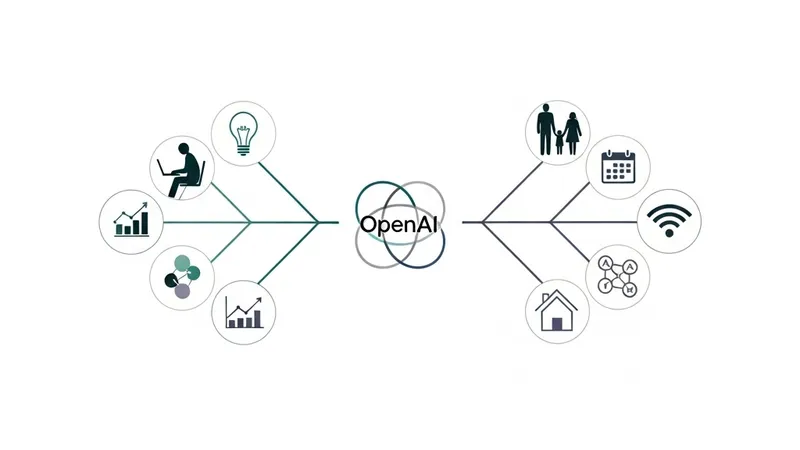
More than three years after ChatGPT’s launch brought generative AI into the mainstream, OpenAI is broadening its focus beyond individual users to families.
OpenAI is hiring a dedicated product manager in San Francisco to build experiences for families, caregivers, and older adults across its products. The role calls for experience building products for parents and families, and other trust-sensitive consumer experiences, according to the job posting.
The hiring comes as #ChatGPT’s audience continues to broaden beyond younger users. According to Sensor Tower estimates, the share of ChatGPT users aged 35 and older globally rose to 31% in Q2 from 26% a year earlier, while the share of users aged 18 to 24 fell to 29% from 34%. In the U.S., nearly one in four smartphone users who are parents used ChatGPT during the quarter, up from 16% a year earlier.
A dedicated product role focused on families signals that #OpenAI is beginning to think about its products less as tools for individual productivity and more as technology designed for households, said Ben Bajarin, chief executive of technology consultancy Creative Strategies. "This is similar to the path Google, Apple, and Meta eventually followed as their platforms became embedded in everyday life, but AI raises the stakes because the assistant is not just mediating content or devices," he said.
That shift also brings new trust and #safety challenges. Stephen Balkam, chief executive of the Family Online Safety Institute, said the hiring reflects both the maturation of OpenAI and a growing recognition that AI products used by children and teenagers require different safeguards than those designed for adults. Balkam described this approach as "safety by redesign," noting that the initial consumer products were not originally built with children in mind.
This is underscored by new research showing parents often underestimate their children's AI usage. While 27% of U.S. parents said their child had used generative AI in the past week, 38% of children reported doing so themselves, highlighting the urgent need for robust parental oversight, age-appropriate content controls, and clear disclosures that users are interacting with AI rather than humans.
[AgentUpdate Depth Analysis] OpenAI's strategic expansion into family-centric products marks a critical transition for AI Agents from single-user productivity tools to collaborative household systems. Unlike enterprise-focused workflows, the domestic environment demands that AI Agents handle multi-user context tracking, complex interpersonal dynamics, and extreme privacy constraints. Historically, smart home hubs from Apple or Google operated on basic, static command structures. Integrating LLM-based Agents introduces long-term memory and proactive orchestration, potentially transforming ChatGPT into a central household manager. However, the stakes are elevated by ongoing legal and ethical concerns regarding underage safety. Succeeding in this space requires a shift toward rigorous localized data alignment and strict guardrails. This expansion will likely set a new benchmark for the broader AI Agent ecosystem, proving whether generative AI can transition from a professional assistant to an indispensable, trusted household companion.