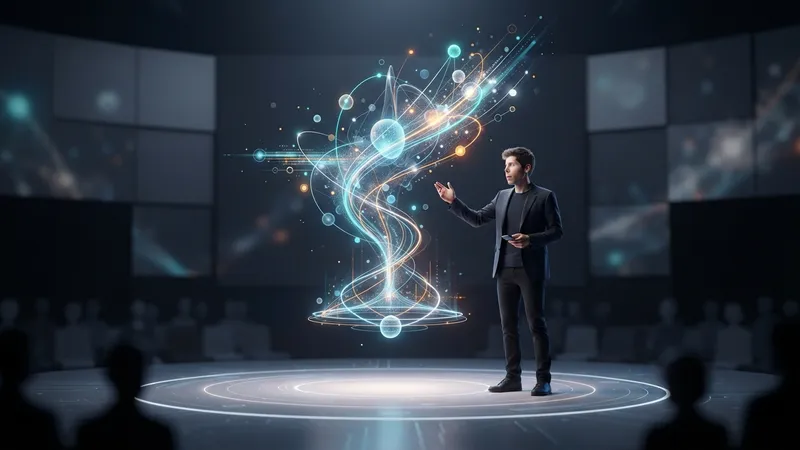
Today, the highly anticipated OpenAI #DevDay 2026 kicked off in San Francisco, featuring a pivotal keynote address by CEO Sam Altman. He unveiled a product he personally has "waited many years for," emphasizing that this represents "what I've always wanted to work with AI." This declaration instantly electrified the audience, signaling a monumental shift in the AI landscape.
The eagerly awaited offering, tentatively named "Project Catalyst," is not merely an iteration of existing models like GPT-4 or the Assistants API, but a groundbreaking platform for highly autonomous AI Agents. This platform aims to equip AI with unprecedented levels of comprehension, planning, and execution capabilities, allowing it to integrate more deeply into complex human workflows and foster true human-AI symbiosis. Altman articulated a vision where AI evolves from a mere tool to a trusted digital colleague.
Key technological highlights of Project Catalyst include deep multi-modal understanding, enabling seamless processing of text, images, audio, and even video; advanced situational awareness to grasp long-term context and intricate task dependencies; and a revolutionary tool-use and self-correction mechanism, allowing agents to autonomously find solutions even when faced with ambiguities. Developers will leverage an intuitive interface to rapidly build and deploy customized #AI agents for a wide array of applications, from coding and data analysis to creative generation and customer service.
OpenAI has also dedicated substantial effort to ensuring the safety and controllability of Project Catalyst. The new safety framework combines the latest advancements in Reinforcement Learning from Human Feedback (RLHF) with proactive "AI alignment" techniques, aiming to minimize potential risks and provide users with transparent control over agent behavior.
This launch is poised to have a profound impact on the global technology industry. It is expected to not only accelerate digital transformation across various sectors but also redefine how we interact with technology. With the proliferation of smarter, more autonomous AI Agents, we anticipate exponential growth in productivity and the unlocking of countless unprecedented innovation opportunities.
[AgentUpdate Depth Analysis] If OpenAI's Project Catalyst indeed delivers on its promise of advanced autonomy and contextual awareness, it will undeniably usher in a transformative era for the current AI Agent ecosystem. Compared to existing popular frameworks like LangChain or CrewAI, Catalyst is likely to offer deeper native integrations, optimized performance, and a streamlined development experience, particularly in multi-modal understanding and complex task orchestration. This could free developers from extensive tool wrapping and process scheduling, allowing them to focus more on agent personalization and core business logic. Horizontally, while Google DeepMind's Project Astra and Anthropic's Claude are exploring similar frontiers in multi-modality and advanced reasoning, OpenAI's significant developer community and market penetration provide a distinct advantage. Catalyst's advent will accelerate the transition of agents from proof-of-concept to widespread commercial deployment, evolving agent technology from mere assistive tools into true intelligent executors. In the long term, this will compel enterprises to rethink organizational structures and workflows, accelerating the adoption of an "Agent-first" application paradigm and potentially triggering a new wave of skill evolution and talent demands.