OpenAI has officially launched GPT-5.6, described by Sam Altman as their most powerful model to date. Alongside a massive upgrade to ChatGPT desktop apps, Codex has been deeply integrated into this next-generation ecosystem, replacing the old setup while the legacy client is rebranded as "ChatGPT Classic."
The community is already exploring its capabilities. Developer Matt Shumer showcased GPT-5.6-Sol autonomously building a voxel-style Manhattan Lego city over a week, while mathematicians used its programmatic workflow to achieve a breakthrough in algebraic geometry concerning K3 surfaces. However, power users noted that the intensive "ultra" mode is highly token-hungry, burning through a 5-hour Pro limit in just 15 minutes.
The new family consists of three models: the flagship Sol, the balanced Terra, and the cost-effective Luna. A key highlight is the new ultra mode, which coordinates 4 to 16 parallel agents to handle highly complex tasks. To optimize efficiency, #GPT-5.6 introduces Programmatic Tool Calling (PTC), letting models write lightweight code to manage tool orchestrations, drastically reducing token overhead and unnecessary model roundtrips.
In the long-horizon Agents' Last Exam benchmark, Sol scored 53.6, outperforming Fable 5 by 13.1 points. In end-to-end task automation, Sol set records with 62.6% on OSWorld 2.0, outperforming Claude Opus 4.8 while saving 85% on output tokens. Additionally, its computer-use capabilities allow it to inspect rendered UI designs and polish them autonomously, enabling smooth, interactive web applications built from scratch.
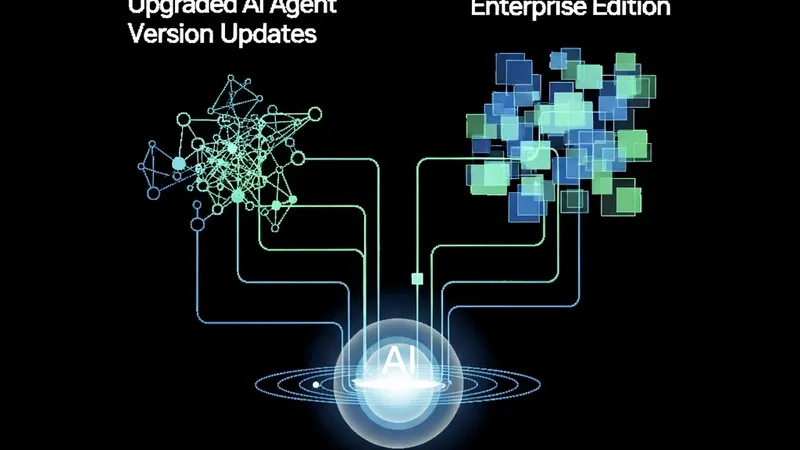
Simultaneously, ChatGPT Work was unveiled. Powered by GPT-5.6 and Codex, it connects to core enterprise tools like Slack, Google Drive, and Teams, executing tasks over hours via Scheduled Tasks to deliver fully polished Excel sheets, slide decks, or websites rather than mere drafts.
[AgentUpdate Depth Analysis] The launch of GPT-5.6, particularly its "ultra" mode and Programmatic Tool Calling (PTC), signals a fundamental architectural shift in the AI Agent ecosystem from single-model reasoning to distributed agent swarms. Traditional multi-agent frameworks often suffer from state-machine explosion and high token overhead. By enabling agents to generate their own orchestration code through PTC, #OpenAI has significantly optimized token efficiency and latency. Furthermore, Sol's performance on OSWorld 2.0 combined with its visual QA ("polishing rendered designs") demonstrates that future agents must transcend code generation and enter a feedback-driven execution loop. For developers, this shifts the competitive landscape of AI agents from pure raw model intelligence to system-level choreography, real-time visual inspection, and seamless enterprise tool integration.