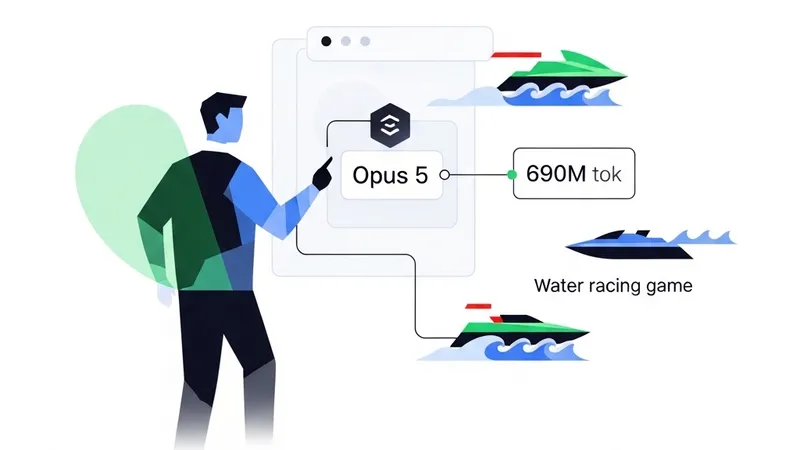
Developer Vyom recently unveiled INK TIDE, a stylized water racing game that has captured the attention of the tech community for its impressive visual fidelity and robust interactivity. The game was generated by Opus 5 using a single, 2,000-word prompt, consuming a staggering 690 million tokens with a development cost of approximately $423. The project is built entirely on Vite, TypeScript, and Three.js, with no external assets; every model, texture, and sound was programmatically generated.
The secret behind this success lies in a sophisticated multi-agent workflow. A master agent handled task decomposition and architectural oversight, while specialized sub-agents managed discrete modules such as water surface rendering, physics, UI, and NPC logic. To combat context dilution, the developer implemented an automated quality assurance agent that utilized screenshot-based feedback loops to refine the game's code iteratively.
Shortly thereafter, developer Anul Agarwal successfully replicated the core mechanics using GPT-5.6 Sol within the Codex environment, incurring a cost of only $5. While the visual polish and intricate details fall slightly behind the Opus 5 version, the accomplishment underscores the immense cost-efficiency of modern LLMs in MVP development.
[AgentUpdate Depth Analysis] This case study highlights two pivotal trends in the evolving AI Agent ecosystem. The first is the triumph of “workflow engineering”: both the Opus 5 and #GPT-5.6 implementations demonstrate that decomposing complex tasks into atomic modules is essential for bypassing context window constraints and ensuring logical consistency. Unlike naive prompting, this #Multi-Agent Orchestration pattern effectively mitigates the “logic drift” and instruction decay often seen in monolithic LLM outputs. Secondly, the trade-off between cost and quality illustrates that AI Agents are transitioning from experimental scripts to robust engineering components. We are witnessing the emergence of agents that function as “closed-loop developers” equipped with CI/CD mindsets. For the broader AI Agent ecosystem, this marks a paradigm shift from “Model-as-a-Service” to “Workflow-as-a-Product,” where developers prioritize standardized inter-agent interfaces and task-completion cycles over raw model parameter scales. As inference costs continue to plummet, specialized, small-scale agent swarms will likely outperform monolithic models in vertical application development.