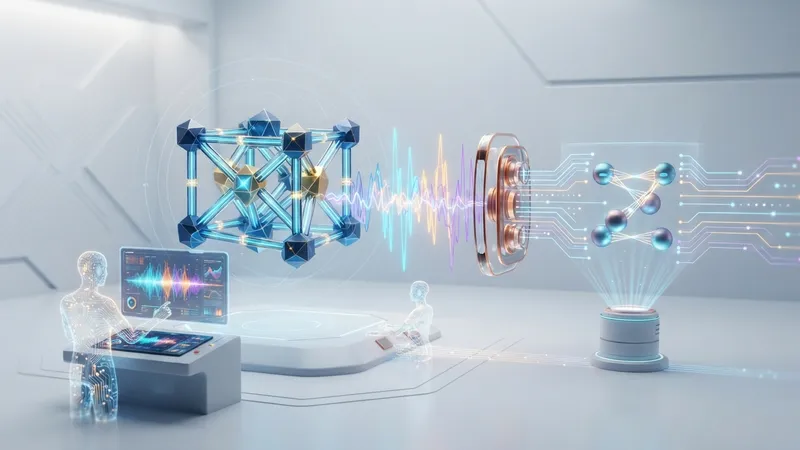
Physicists have cracked a long-standing #superconductor mystery by analyzing electrical noise. The team at Argonne National Laboratory measured noise spectra in a cuprate superconductor near its critical temperature and found that noise patterns directly correlate with fluctuations of the electronic nematic phase.
Traditionally, superconductor research relies on resistance and magnetic susceptibility measurements, but noise analysis captures subtler dynamic processes. Using a SQUID, the team recorded voltage fluctuations at ultra-low temperatures and observed anomalous noise peaks in a specific temperature range. These peaks correspond to competition between the nematic phase and the superconducting phase.
The finding supports the theory that nematic fluctuations promote superconducting pairing, offering new evidence for understanding high-temperature superconductivity. The researchers say noise spectroscopy can be extended to other strongly correlated electron systems, potentially accelerating the search for room-temperature superconductors.
[AgentUpdate Depth Analysis] This research, though a fundamental physics breakthrough, holds profound implications for the AI Agent ecosystem. Noise analysis as a passive sensing method mirrors how AI Agents infer internal states from environmental signals. For instance, in multi-agent systems, agents could monitor communication noise to predict coordination conflicts; in reinforcement learning, noise spectra could aid exploration strategies. Integrating physics-inspired noise analysis into agent design may enhance system robustness. The principle of "fluctuations promoting order" also parallels how diversity drives innovation in agent ecosystems. Keep an eye on scientific discovery agents leveraging similar noise signals to accelerate materials simulation—this could be the next breakthrough in AI for Science.