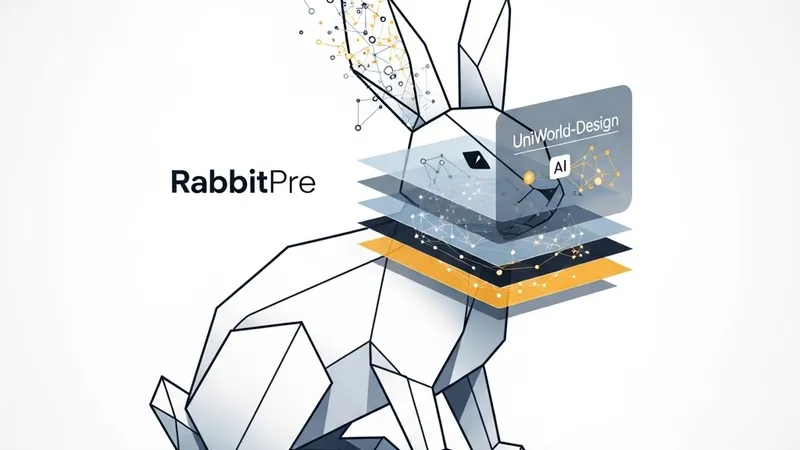
Over the past two years, large AI models have completely reshaped the content production industry. In the visual field, AI has evolved from generating deformed hands to creating complex posters and high-density typography. However, as AI image generation is no longer breaking news, the industry is left wondering: what is the next step? To address this, RabbitPre has officially launched its latest AI design and production tool, RabbitVis, database of layers, aimed at walking through the entire design workflow.
Industry analysis suggests that AI is rapidly transitioning from general capability competition to scene-specific capability competition. While foundation models provide the underlying power, it is the targeted products that truly create value for users. The real pain point for designers and marketers is not the lack of an AI that generates images, but the lack of a tool that completes the entire workflow. Previously, RabbitPre collaborated with Peking University and Peng Cheng Laboratory to develop UniWorld-View, which topped the WorldScore world model leaderboard. Now, they have translated this technical accumulation into UniWorld-Design and launched #RabbitVis.
In real-world commercial design, the actual work often begins after the image is generated. When faced with editing requests like "move the logo to the left" or "enlarge the font size", traditional flattened AI images fall short, forcing users to rely on professional software like Photoshop. RabbitVis solves this "second half" of the process. Instead of producing static, unalterable images, it brings AI deep into layer-level one-stop editing, lowering the barrier to professional design.
The continuous editing capability of RabbitVis is supported by the underlying model's structural generation. UniWorld-Design uses layers as the core organizational method, supporting transparent asset generation (T2RGBA) and image-to-layer (I2L) separation. In evaluations, its I2L visual quality metric RGB L1 reached 0.1264, Alpha Soft IoU reached 0.7325, and editability scored 1.32. In T2RGBA evaluations, its semantic matching capability reached a CLIP Score of 33.03, transforming AI outputs into reusable "design assets".
[AgentUpdate Depth Analysis] From the perspective of the AI Agent ecosystem's long-term evolution, the "layer-level structural generation" demonstrated by RabbitVis represents a critical technological paradigm shift. Traditional visual generators like Midjourney operate as "black boxes" of flattened pixels, which are difficult for downstream AI Agents to parse or manipulate. Future multimodal Agents must interact seamlessly with both physical and virtual environments, requiring the ability to identify, manipulate, and reconstruct individual spatial elements. The layer separation and transparent asset generation of #UniWorld-Design essentially provide multimodal Agents with precise visual perception and manipulation interfaces. When Agents can programmatically call, edit, and reorganize visual layers like human designers, it paves the way for fully autonomous, closed-loop UI and marketing Agents. This is not just an upgrade for design tools; it establishes the foundational data architecture for next-generation spatial intelligence.