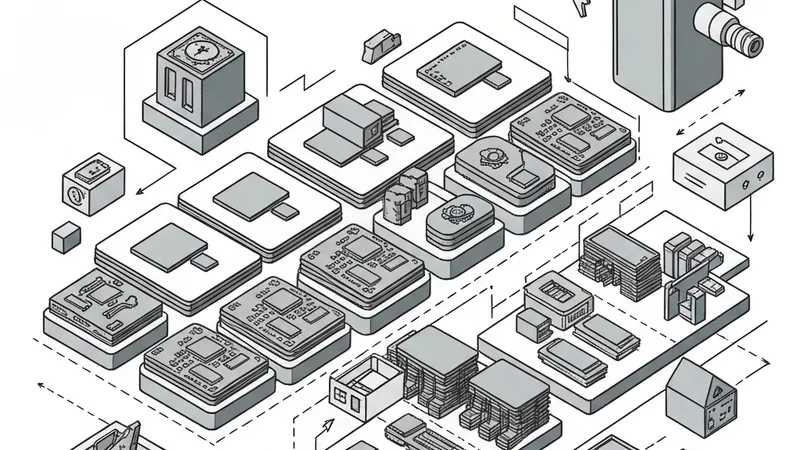
According to industry sources, semiconductor giant Samsung Electronics is planning to build a new advanced DRAM fabrication line at its Giheung campus in South Korea. The move is designed to scale up the production of next-generation High Bandwidth Memory (HBM) and advanced DDR5 chips, addressing the skyrocketing demands of the AI and high-performance computing (HPC) sectors.
The Giheung campus, historically significant for #Samsung's semiconductor division, will host this new facility leveraging extreme ultraviolet (EUV) lithography. The production line will target advanced #DRAM nodes. Industry analysts suggest that as Large Language Models (LLMs) evolve into multimodal systems and complex AI Agents, the hardware requirement for ultra-high memory bandwidth and energy efficiency has escalated to unprecedented levels.
Under intense competition from SK Hynix and Micron, Samsung's expansion in Giheung is critical to maintaining its dominance in the global memory market. The new facility will play a vital role in securing high-volume manufacturing of HBM3E and next-generation HBM4, ensuring stability in the global AI hardware supply chain.
[AgentUpdate Depth Analysis] As AI Agents transition from cloud-reliant architectures to autonomous, on-device operations, memory bandwidth and latency have emerged as critical bottlenecks for real-time reasoning and long-context processing. Samsung's strategic expansion in Giheung represents a foundational shift to build the hardware bedrock for the future Agentic era. While SK Hynix currently leads the #HBM market, Samsung's aggressive investment in next-gen advanced DRAM and HBM4 aims to lower power consumption and latency for local Agent execution (on AI PCs, smartphones, and robotics). Ultimately, ultra-fast, high-capacity DRAM will empower Multi-Agent Systems to run complex, real-time local loops, breaking free from costly cloud API dependencies and driving widespread adoption of edge-based AI Agents.