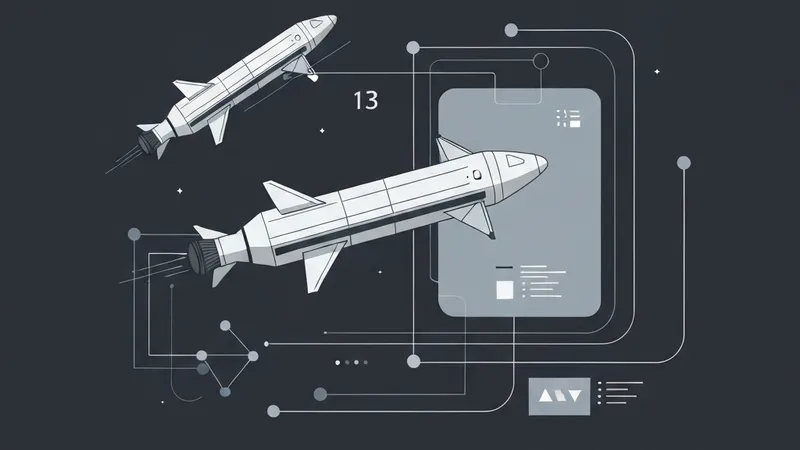
In early August 2026, the global frontier of aerospace and high-tech supply chains witnessed several milestones. Leading the charge, SpaceX's retrieval team is currently processing the aftermath of its 13th Starship test flight. CEO Elon Musk revealed on August 7 that while the recovery was "not optimistic," the engineering team harvested critical telemetry from the thermal tiles and Raptor 3 engines. Measuring 52 meters in length and wrapped in 18,000 heat-shield tiles, this prototype splashed down in the Indian Ocean on July 24 and remained floating fully intact—marking the best-preserved Starship hardware to date.
Meanwhile, aboard the International Space Station (ISS), human spaceflight continues to push operational boundaries. On August 6, NASA astronauts Jessica Meir and Anil Menon conducted the year's 4th spacewalk, lasting 6 hours and 27 minutes to install structural cables for new solar arrays. However, due to a carbon dioxide sensor anomaly detected in Menon's spacesuit, NASA ground teams postponed the next spacewalk to August 18 for comprehensive assessments. During his orbit, Menon also captured stunning imagery of the massive Typhoon Dolphin, a category-14 storm with wind speeds of 45 m/s and a circulation diameter exceeding 1,000 kilometers, currently threatening coastal China.
On the terrestrial front, critical mineral supply chains—the bedrock of high-tech manufacturing—are undergoing strategic shifts. U.S. President Donald Trump hosted a mining roundtable in Washington, announcing a 2-billion-dollar federal investment to bolster critical mineral extraction and processing. This initiative aims to reduce offshore manufacturing dependencies. A recent Congressional report noted that 78% of components in the U.S. defense sector, and up to 92% in naval weapon systems, currently rely on external mineral supply chains.
[AgentUpdate Depth Analysis] From Starship's resilient ocean splashdown to the spacesuit CO2 sensor anomaly, these highly complex engineering paradigms highlight a fundamental transition: system management in extreme environments is moving from manual oversight to autonomous AI Agents. The future of aerospace and deep-tech manufacturing demands robust fault tolerance and real-time multimodal diagnosis. While today's AI Agent ecosystem focuses heavily on software-centric pipelines, the real frontier lies in embodied intelligence and edge industrial control. Cross-examining current technologies, integrating physical telemetry with Agentic reasoning protocols (such as Model Context Protocol or decentralized IoT networks) will allow localized Agents to diagnose and self-heal complex mechanical systems without waiting for ground control latency. This paradigm shift will redefine the long-term roadmap for aerospace, heavy robotics, and smart supply chain ecosystems.