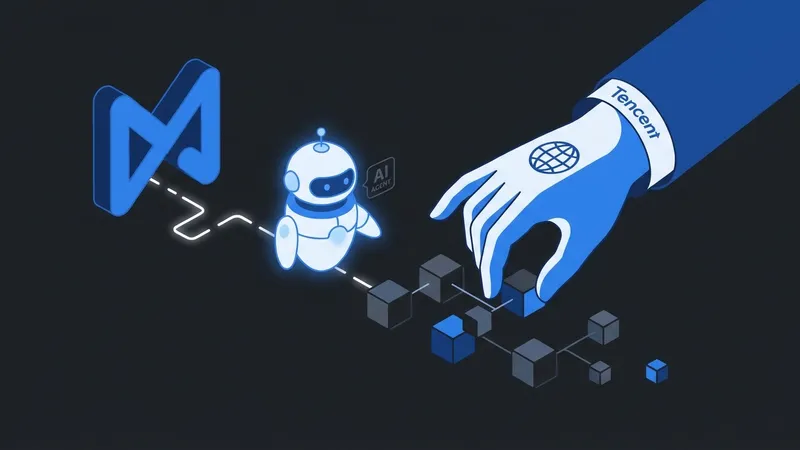
According to a report by the Financial Times, Chinese tech giant Tencent is leading a deal to unwind Meta's planned $2 billion #acquisition of the viral AI Agent startup Manus. This rare intervention highlights the intensifying battle between US and Chinese tech conglomerates over the control of frontier artificial intelligence technologies.
Sources familiar with the matter revealed that Manus (developed by its parent company Monica) recently triggered a global sensation with its general-purpose AI Agent capable of executing complex, multi-step digital tasks. Social media giant Meta quickly stepped in with a massive $2 billion acquisition offer to bolster its generative AI pipeline. However, #Tencent, an early backer of Monica, chose to invoke its preemptive rights or orchestrate a restructuring consortium to block the takeover.
Analysts suggest that the friction surrounding the deal stems not only from commercial rivalry but also from regulatory complexities and national security sensitivities. Because #Manus's technology involves highly advanced autonomous agent frameworks, a complete buyout by a US tech giant could face intense regulatory hurdles. The Tencent-led alternative would allow the startup to maintain relative independence while keeping its IP within the existing investor ecosystem.
While Tencent, Meta, and Monica have declined to comment, the struggle underscores how the AI Agent sector has quickly evolved from product-level competition to high-stakes geopolitical and capital warfare among trillion-dollar tech titans.
[AgentUpdate Depth Analysis] The battle over Manus marks a critical turning point for the AI Agent ecosystem, emphasizing the transition from foundational LLMs to action-oriented autonomous agents. Tencent's aggressive move to block Meta's $2 billion acquisition is a strategic defense of the next-generation human-computer interface. Compared to closed ecosystems like Microsoft Copilot or Anthropic's Computer Use, Manus represents a highly disruptive end-to-end web agent. Had Meta secured this acquisition, it would have significantly altered the competitive dynamics of global consumer AI. This intervention signals that future M&A activities in the AI Agent space will face intense geopolitical and antitrust scrutiny, transitioning the ecosystem from open collaborative exploration into a highly fragmented, giant-led era.