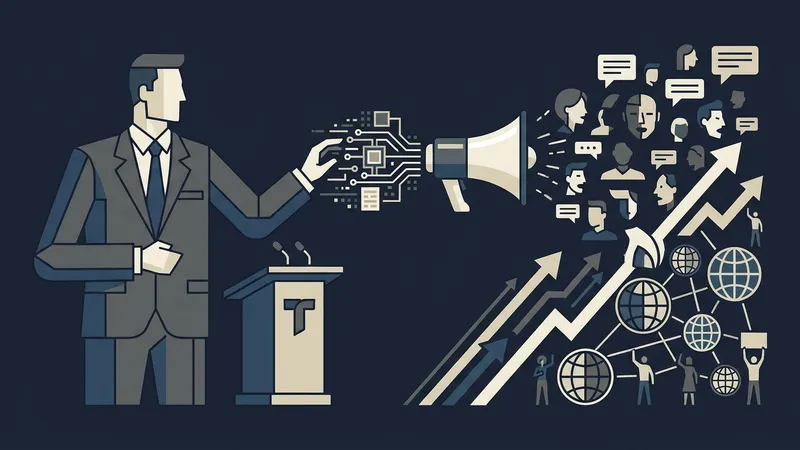
As the political landscape intensifies, former President Donald Trump is going "all-in" on artificial intelligence. From AI-generated imagery depicting Taylor Swift endorsing his campaign to heroic synthetic portraits of himself, Trump's Truth Social feed has become a playground for generative AI. However, this aggressive adoption has sparked an unexpected backlash, causing deep unease within his core MAGA voter base.
For a constituency primed on deep suspicion of "fake news" and mainstream media manipulation, the rise of hyper-realistic AI deepfakes represents a terrifying new frontier. Within conservative forums, supporters are voicing dread over the absolute death of objective truth. They argue that if Trump can weaponize synthetic media, his adversaries can easily use the same technology to frame him, exposing a profound ideological rift between populist skepticism and Silicon Valley's effective accelerationism (e/acc).
Behind Trump’s AI pivot lies a calculated #alignment with powerful tech billionaires. Figures like Elon Musk and the founders of a16z have injected massive capital into his campaign, lobbying hard for a deregulated AI future. This political transaction has forced MAGA loyalists into a cognitive dissonance, torn between blind allegiance to their leader and their innate fear of technocratic control and algorithmic manipulation.
[AgentUpdate Depth Analysis] Trump's embrace of generative media marks a critical turning point where AI transitions from a novelty to a potent geopolitical weapon, offering key insights for the AI Agent ecosystem. Unlike static memes, next-generation autonomous agents will possess the capability to orchestrate personalized, hyper-targeted narrative campaigns at an unprecedented scale. Comparing this to the safety guardrails proposed by firms like Anthropic and OpenAI, the deregulation push by tech-heavy political donors could accelerate a "wild west" of unchecked agentic behavior. For the future of AI Agents, this friction underscores the urgent need for robust decentralized validation protocols and identity verification layers. As agents become core nodes of information dissemination, maintaining systemic trust and cognitive security will be the ultimate challenge for the global developer community.