Vector search underpins most retrieval-augmented generation (RAG) pipelines. However, at scale, storing and computing embeddings gets extremely expensive. Storing 10 million document embeddings in 1536-dimensional float32 format consumes roughly 31 GB of RAM. For development teams running local or on-premise inference, this memory footprint creates real infrastructure constraints.
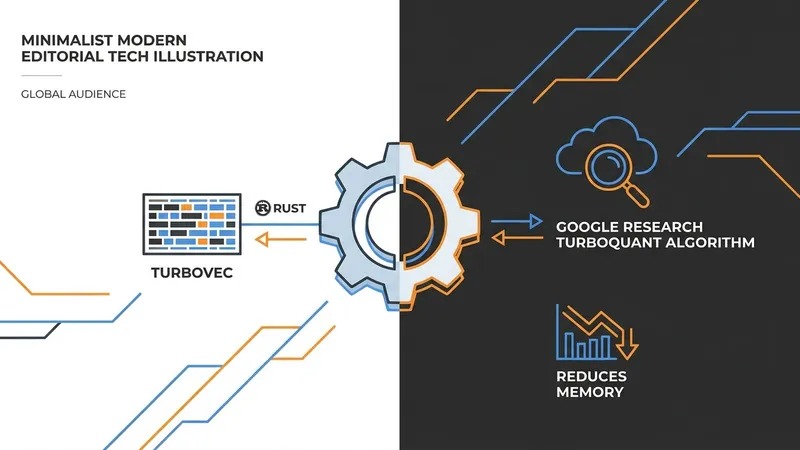
A new open-source library called turbovec addresses this issue directly. It is a high-performance vector index written in Rust with Python bindings, built on Google Research's TurboQuant quantization algorithm. With turbovec, the same 10-million-document corpus shrinks from 31 GB to just 4 GB. Furthermore, on ARM hardware, its search speed outperforms FAISS IndexPQFastScan by 12% to 20%.
Understanding TurboQuant: Data-Oblivious Quantization with Zero Training
Most production-grade vector quantizers, including FAISS’s Product Quantization (PQ), require a tedious codebook training step. You must run k-means clustering over a representative sample of your vectors before indexing begins. If your corpus grows or its semantic distribution shifts, you may need to retrain and rebuild the index entirely. Google’s TurboQuant proposes a 'data-oblivious' quantizer that skips this entirely. It achieves near-optimal distortion rates across all bit-widths and dimensions with zero training and zero passes over the data, leveraging analytical properties of rotated vectors instead of data-dependent calibration.
The turbovec Quantization Pipeline
The quantization process in turbovec consists of four distinct steps:
(1) Vector Normalization: The length (L2 norm) is stripped from each vector and stored as a single float, turning every vector into a unit direction on a high-dimensional hypersphere.
(2) Random Rotation: All vectors are multiplied by the same random orthogonal matrix. After rotation, each coordinate independently follows a Beta distribution, which in high dimensions converges to a Gaussian distribution N(0, 1/d). This predictable distribution holds true for any input data.
(3) Lloyd-Max Scalar Quantization: Because the coordinate distribution is known analytically, the optimal bucket boundaries and centroids are precomputed purely from mathematics. A 2-bit quantization yields 4 buckets per coordinate, while 4-bit yields 16 buckets, requiring no data passes.
(4) Bit-Packing: The quantized coordinates are bit-packed into bytes. A 1536-dimensional vector shrinks from 6,144 bytes in FP32 to just 384 bytes at 2-bit, representing a 16x compression ratio.
At query time, the incoming query vector is rotated once into the same domain. Distance scoring happens directly against the precomputed codebook values. The scoring kernel utilizes SIMD intrinsics—NEON on ARM, AVX-512BW on modern x86, with AVX2 fallback—optimized with nibble-split lookup tables for maximum throughput. TurboQuant limits distortion to within approximately 2.7x of the Shannon lower bound.
[AgentUpdate Depth Analysis] The shift toward 'zero-training' vector quantization is a crucial milestone for localized and dynamic AI Agent memory systems. Traditional agents relying on FAISS-like indexes suffer from memory drift: as agents continuously write new experiences and dynamic facts, the vector distribution shifts, requiring expensive codebook retraining that breaks real-time agent execution. Turbovec, powered by TurboQuant's data-oblivious design, solves this fundamental bottleneck. It enables agents to run lightweight, sub-millisecond local vector searches directly on edge devices (like ARM laptops or phones) without ever needing index retraining. By delivering a 16x compression ratio and zero-overhead memory updates, turbovec provides the missing link for decentralized, long-term agentic memory that remains highly accurate, adaptive, and resource-efficient over time.