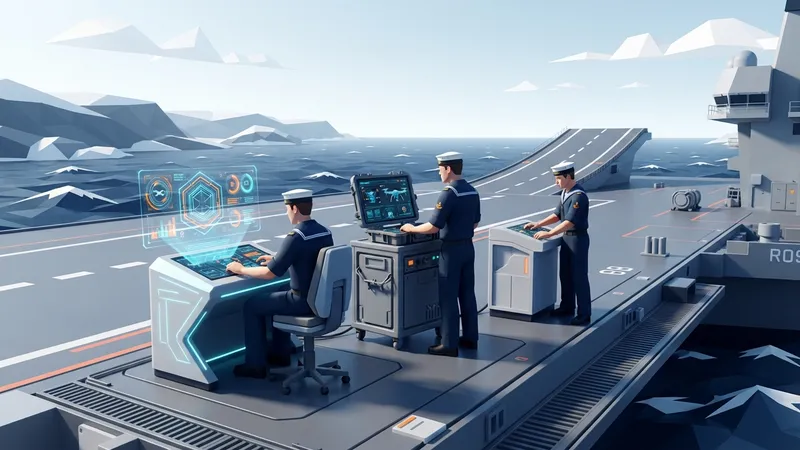
Fog hangs low over Norway's jagged coastline as a British helicopter flies out over the frigid waters below. The days are growing colder, bringing worsening weather and decreased daylight to the High North. The helicopter, a Merlin Mk4, lands on the flight deck of the HMS Prince of Wales, the Royal Navy's flagship. Wind whips across the deck as sailors bundled in protective gear move F-35 stealth fighter jets into position. By early afternoon, the sun is already sinking toward the horizon, complicating operations as the light fades away.
Business Insider visited the Prince of Wales, the lead ship for the UK's carrier strike group, in early November while it was underway in the Norwegian Sea. The ship's deployment is part of the second phase of Operation Firecrest, a deterrence mission in the #Arctic and North Atlantic.
Sailors are training to fight through darkness, rough seas, and radio silence to prepare for the harsh conditions of the Arctic winter. The training aims to ensure the carrier strike group can maintain operational capability in extreme environments, including low visibility and limited communications.
The training includes launching and recovering aircraft in simulated bad weather, conducting deck operations, and coordinating the actions of the carrier air wing. Sailors must also learn to communicate under radio silence using visual signals and pre-arranged protocols, which is crucial for maintaining stealth in enemy electronic warfare environments.
The deployment underscores the UK's strategic interests in the Arctic and the Royal Navy's commitment to maintaining operational readiness in extreme conditions. As melting Arctic ice opens new shipping routes and resources, the region's military significance is growing.
[AgentUpdate Depth Analysis] The UK carrier's Arctic winter training, while seemingly traditional military news, actually reveals key challenges for the future AI Agent ecosystem: autonomous decision-making and communication degradation in extreme environments. When radio silence is enforced, crew rely on visual signals and pre-arranged protocols—similar to coordination mechanisms in #multi-agent systems under communication constraints. Current mainstream frameworks like LangChain and CrewAI rely on centralized message passing, and collaboration collapses if the network fails. Future agents need "disconnected autonomy" capabilities, maintaining task continuity through local perception and predefined strategies. Moreover, the coordination between F-35s and shipboard systems resembles tool invocation among agents, but latency and bandwidth limits demand more efficient edge computing. The harsh Arctic conditions are the ultimate test of robustness; the AI Agent ecosystem must learn from military systems' redundancy and degraded modes to survive real-world unreliable networks. This is not just a technical issue but an architectural philosophy: distributed intelligence must still achieve global goals when communication is constrained.