In early August 2026, critical advancements were made across global tech supply chains, space exploration, and environmental monitoring. On the geopolitical and industrial front, US President Donald Trump hosted a mining roundtable in Washington, announcing a $2 billion federal investment in critical minerals. This initiative aims to integrate advanced technologies to expand domestic extraction and processing, reducing reliance on external supplies. A congressional report revealed that in 2025, approximately 78% of components in the US defense system relied on foreign critical mineral supply chains, with naval weapons systems dependency reaching 92%.
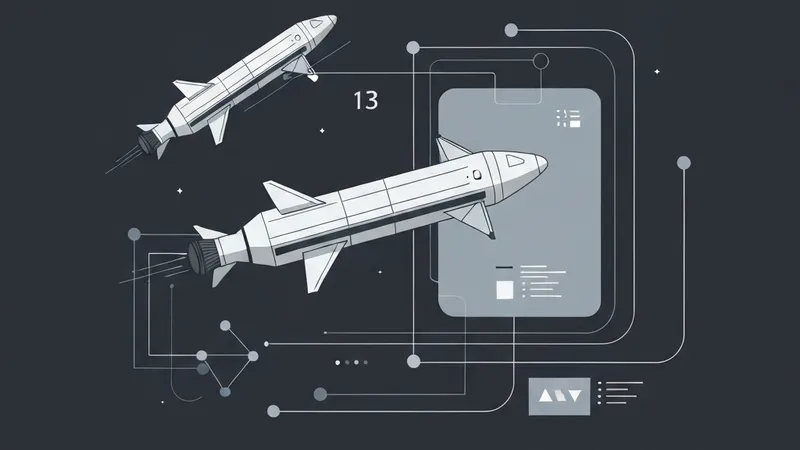
In aerospace, SpaceX is actively retrieving its Starship prototype from its 13th test flight in the Indian Ocean. Although CEO Elon Musk noted the recovery outcome was "not optimistic," the engineering team successfully gathered crucial telemetry data from the spacecraft's heat shield and 6 Raptor 3 engines. This 52-meter vessel, covered in 18,000 thermal tiles, provides invaluable physical data to refine future simulations and autopilot telemetry.
Meanwhile, NASA astronauts Jessica Meir and Anil Menon completed the ISS's fourth spacewalk of 2026, lasting 6 hours and 27 minutes. However, due to a CO2 sensor telemetry anomaly in Menon's spacesuit, NASA ground engineers delayed the subsequent spacewalk to August 18 for comprehensive diagnostic analysis using automated telemetry pipelines.
Additionally, extreme weather events—such as Typhoon Dolphin threatening coastal China and record-breaking heat waves in Rome exceeding 40°C—highlight the growing reliance on real-time IoT sensors and predictive simulation systems to manage smart cities and emergency response logistics.
[AgentUpdate Depth Analysis] The intersection of SpaceX's telemetry retrieval, NASA's sensor fault detection, and resilient supply chain logistics underscores a critical bottleneck in the AI ecosystem: the transition of AI Agents from purely digital environments to physical-world execution. The future of AI Agents lies in "embodied industrial intelligence," where frameworks like LangChain and MCP must interface seamlessly with heterogeneous edge sensors and real-time physical telemetry. By integrating multi-modal AI Agents into supply chains and aerospace diagnostics, systems can transition from passive monitoring to active, autonomous fault-tolerance and self-healing. This paradigm shift will redefine the scalability of both critical heavy industries and deep-tech space exploration.